Service Autopilot for Lawn Care: Is It the Right Fit?
60-Second Answer
Is Service Autopilot right for lawn care?
Service Autopilot is a strong fit for lawn care and landscape maintenance businesses running 3 to 25+ crews with high-volume recurring residential routes, especially those that need built-in chemical application tracking for state pesticide and fertilizer compliance. It is a weaker fit for solo operators and very small crews, since pricing starts at $49/month but the features most lawn care owners actually want (job costing, route optimization, automation) sit in the $199 to $499/month tiers, and the mobile app draws consistent criticism from field technicians.
Selecting the right field service management software for your lawn care business isn’t about features. It’s about the fit: does this platform accommodate the realities of your crews, the payment preferences of your clients, and the pace of your growth? From my own experience, the vast majority of lawn care business owners who regret their platform choice don’t select a “bad” software. They select an option designed for a company 3x larger (or smaller) than their own.

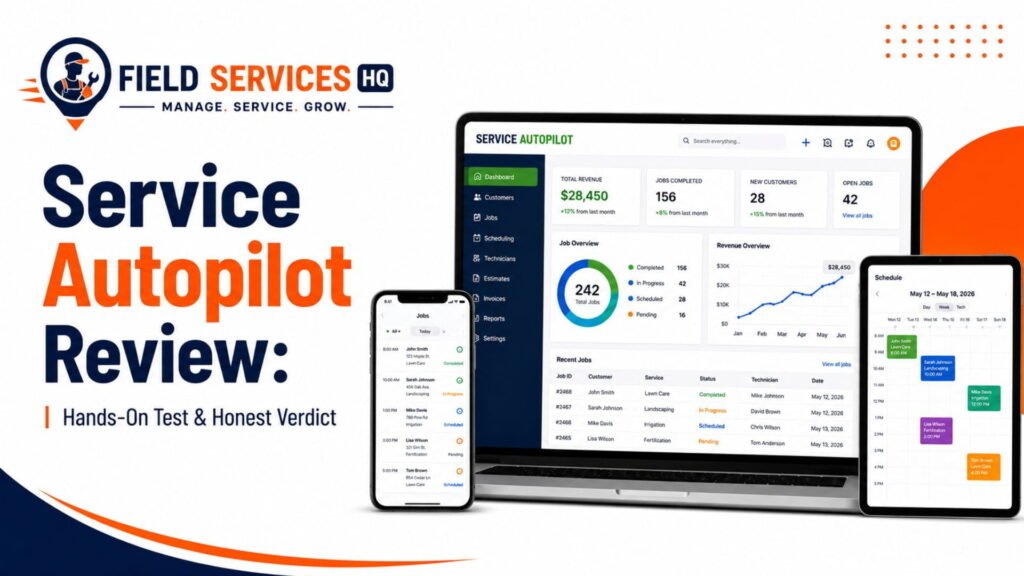
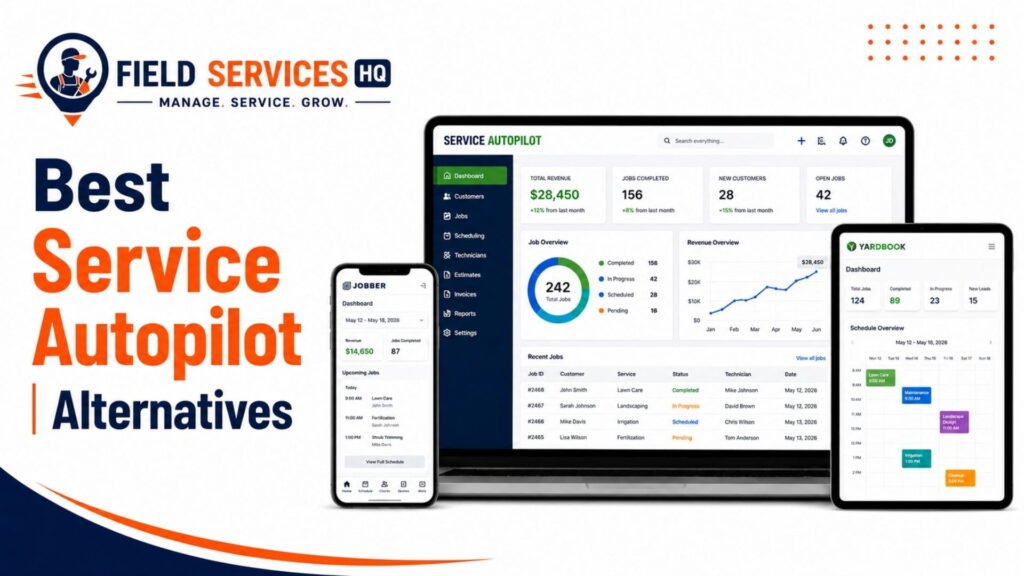
This guide will help you understand where Service Autopilot lands in the lawn care software ecosystem: the realities it’s designed to handle, the costs at each growth stage, the options for mowing, fertilizing, and other landscape maintenance scheduling, and its limitations. For comprehensive information on any particular aspect of this software, consult our Service Autopilot review, our granular Service Autopilot pricing analysis, and our Service Autopilot alternatives comparison.
Quick Decision Table
| If your business looks like this… | Service Autopilot fit |
|---|---|
| Solo operator or 1-2 person crew, under 100 recurring accounts | Weak fit. Cost and complexity outweigh the benefit at this stage. |
| 3-10 crew lawn care company with recurring mowing/fertilization routes | Strong fit, especially with chemical application programs. |
| 10-25+ crew landscape maintenance or lawn care company, multiple service lines | Strong fit if the Pro Plus or Elite tier budget is realistic. |
| Design-build or installation-heavy landscaping company | Moderate fit. Better suited to companies where recurring service revenue dominates. |
| Business that also does snow removal or holiday lighting | Strong fit; Service Autopilot supports seasonal service switching in one system. |
| Technicians who need a fast, simple mobile experience above all else | Weaker fit. Mobile app reliability is a recurring complaint in user reviews. |
Service Autopilot for Lawn Care Review: A Bird-Eye View Essay
Quick summary: Service autopilot is a field service management software that is primarily used by recurring service companies. It is perfect for lawn care, landscaping, pest control, and snow removal industries. It offers scheduling, dispatching, CRM, invoicing, automation, and chemicals tracking features.
Capability Matrix
| Capability | Service Autopilot Coverage |
|---|---|
| Recurring service scheduling | Strong. Purpose-built for weekly/biweekly route-based service. |
| Route optimization | Included starting at the Pro tier, sold as an add-on module on some plans. |
| Chemical/pesticide application tracking | Strong. Logs product, quantity, lot number, and application area for compliance reporting. |
| Job costing and profitability reporting | Available from Pro tier up; full custom reporting requires Pro Plus. |
| CRM and lead management | Strong. Built as a core module, not an afterthought. |
| Mobile app for field technicians | Weak point. Consistently criticized in independent reviews for bugs and sync issues. |
| QuickBooks integration | Available, but frequently billed as a separate add-on. |
| Automation (follow-ups, reminders, review requests) | Strong, especially at Pro Plus and Elite. |
| Ease of onboarding | Moderate to difficult. Multiple reviewers cite a real learning curve. |
What Does a Lawn-Care Business Actually Need From FSM Software?
Before looking at any particular platform, it helps to identify the specific job that a software solution needs to get done. Lawn care is a recurring-revenue, route-based service business, which creates different software requirements than other recurring revenue industries like roofing or electrical.
Recurring Services
Lawn care is largely a weekly or biweekly mowing, seasonal fertilization, and aeration/service business. The software should allow automatically generating these recurring work orders, instead of having technicians reconstruct them every week.
Scheduling & Routing
Because the typical stop is short (15 to 45 minute intervals) and the density of stops in a service area is high, routing efficiency has a large impact on the margin of a route.
Crew Management
Crews (groups of technicians) rather than individual technicians are the scheduling unit in lawn care operations. The software needs to schedule and track jobs for a crew rather than an individual technician, and the time spent on a job should be tracked at the crew level.
Customer Management
Lawn care customer relationships are driven by historical service information, property notes (dog, gate code, sensitive areas), and pre- and post-visit communication.
Estimates & Sales
Property measurement and online estimates are more crucial in lawn care than other trades, because the competition for residential service contracts is often a phone call away.
Billing & Payments
Recurring monthly or per-visit billing needs to be automatic. Manually invoicing hundreds of weekly customers isn’t an economically viable option beyond a handful of crews.
Job Economics
The business needs to understand the cost per visit (labor, fuel, chemicals) versus the revenue per visit, at the level of the service type, crew, and customer (not just overall revenue).
How Service Autopilot Handles Lawn-Care Operations
Scheduling
The software allows recurring service scheduling templates, so that weekly mowing or seasonal fertilization can be scheduled as a repeating service rather than having to manually build it week over week.
Routing
Route building and optimization features are available, with mixed results from users. Several reviewers note that the software’s routing tools are adequate but not above average, requiring more clicks to rearrange stops between routes. One reviewer notes the Pro plan at $199/month includes employee and asset tracking, job costing and route optimization, suggesting that route optimization is not part of the Startup tier.
Customers & Properties
The CRM tracks service history, property notes, and GPS-based property measurement, so that an agent can look up an estimate for a property online without an onsite visit (a time-saving feature for lawn care estimating).
Estimates
Estimates can be built on the measured property data, allowing office staff or lead technician to turn a lead into a priced estimate without a separate visit for straightforward mowing accounts.
Invoicing & Payments
Recurring and one-time invoicing is automated, but connecting to QuickBooks is presented by several reviewers as a separate add-on rather than part of the base software, which affects the comparison at the all-in monthly price point.
Crew Management
Time clock features allow crews to clock in/out per job and track labor cost, which is one of the features reviewers at Capterra highlight as a strong point.
Mobile Operations
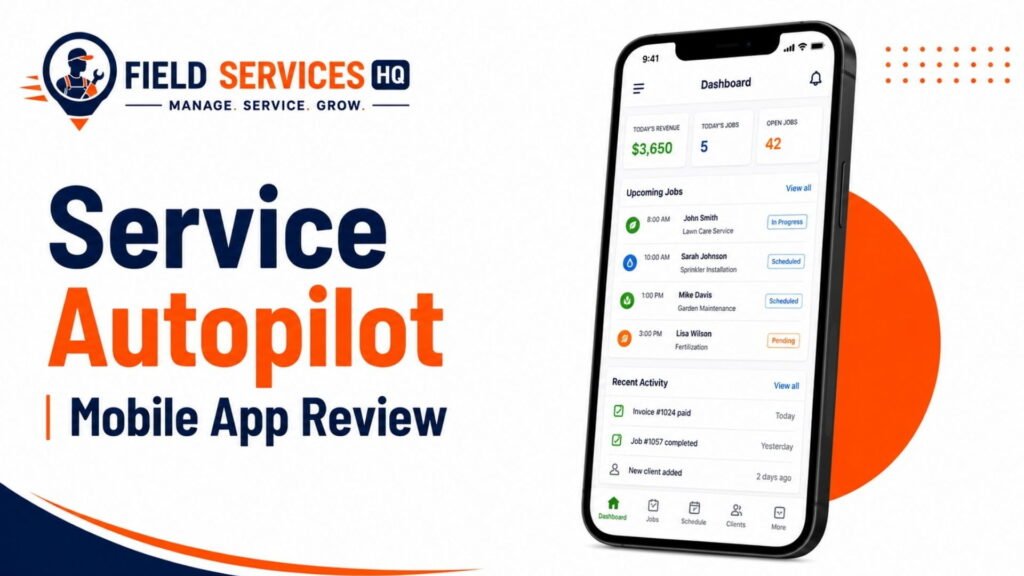
This is the software’s weakest area. Users frequently report issues with mobile app syncing and data consistency across devices, and reviewers at Capterra report the software as buggy with a slow interface. If your crews are not office staff, and a responsive, quick mobile app is necessary for the technicians’ workflow, consider this carefully. See our full Service Autopilot Mobile App Review for a technician-level perspective.
Can Service Autopilot Help Lawn-Care Businesses Track Profitability?
Straightforward answer: Yes, but the ability to track profitability (job costing, labor cost analysis, and reporting) is only available at the Pro and Pro Plus levels, not the entry-level Startup pricing, and the value of the software is higher than the base-plan cost suggests.
Job Costing
Job costing in Service Autopilot ties the actual labor, material, and chemical cost to the job or contract, which is the only way to evaluate whether a service account is being profitable.
Labor Costs
Labor cost per job via the time clock is valuable, as mean hourly wages for landscaping and groundskeeping rose 6.4% from 2022 to 2024, according to BLS OEWS data, making it more challenging to keep margin stable.
Chemical & Material Costs
Chemical application tracking, logging the product, quantity, lot number, and area treated, serves as both a regulatory record and a cost tracker, as chemical cost is a direct, trackable cost per job or visit.
Estimate vs Actual
The comparison between the estimate and actual labor/material cost is how a business identifies scope creep or underpricing, once it has occurred on a particular job.
Service-Level Profitability
Reporting can be filtered by service type, which is useful for identifying whether, say, fertilization programs tend to have a better margin than mowing-only accounts.
Customer Profitability
Not all recurring customers are equal, even with the same service package. Customer-level reporting can help identify opportunities to re-price accounts or discontinue unprofitable ones.
Route Profitability
Since density of stops drives the efficiency of a route, route-level reporting can identify which areas have a better or worse margin, on average.
Crew Productivity
Revenue and jobs per day per crew is a productivity metric that can be built with the reporting tools (Pro Plus tier), but it is not available as a pre-built report.
What the Data Says About Lawn-Care Business Economics
Having an understanding of the economics of the industry you’re operating in puts any software purchase in perspective. Here is what the data currently shows — and what it means for you if you’re running a lawn-care business.
Lawn Care Industry Snapshots
- $188.8B — U.S. landscape services market size, 2025 (NALP/IBISWorld)
- 692,777 — Landscaping service businesses in the U.S. (NALP/IBISWorld)
- 1.4M+ — People employed across the industry (NALP/IBISWorld)
- 25–40% — Typical direct labor cost as a share of revenue (directional industry benchmark)
The Landscape Services Industry Is Large — and Expanding, But Extremely Competitive
The U.S. landscape services industry was valued at $188.8B in 2025, distributed among 692,777 landscaping service businesses, according to the National Association of Landscape Professionals (NALP), citing IBISWorld data.
What it means for lawn-care owners: A market capitalization this large, divided among nearly 700,000 businesses, means the typical business is relatively small — most lawn-care companies aren’t competing on an ultra-scale basis, but rather on route density, retention, and reputation within their given market. Growth in overall market size doesn’t automatically translate to opportunity for any particular operator; rather, increased competition for the same homeowners’ budgets.
Per NALP, the industry grew at an average rate of 6.5% per year between 2020 and 2025, and is projected to reach $203.8B by 2030 (Grand View Research), representing a 7.3% CAGR between 2023 and 2030.
What it means for lawn-care owners: Mid-to-high single-digit growth in the overall size of the market is positive news for demand, but it also invites new entrants and converts from adjacent industries. If your own revenue growth isn’t at least matching the overall industry CAGR, you’re likely losing market share to more aggressive competitors, even as the total amount of revenue increases.
Labor Is Becoming Scarcer — Not More Abundant
The Bureau of Labor Statistics (BLS) projects grounds maintenance worker employment to grow 5% between 2025 and 2035, adding approximately 60,100 jobs — of which landscaping and groundskeeping workers will comprise approximately 55,600.
What it means for lawn-care owners: A need for this many new field workers represents considerable strain on the labor market, and will force employers to compete for available workers. This isn’t a short-term phenomenon — these are cumulative numbers from 2025 to 2035.
As of May 2025, the BLS reports a median hourly wage of $19.27 for grounds maintenance workers and $18.82 for landscaping and groundskeeping workers specifically.
What it means for lawn-care owners: Hourly wage benchmarks such as this are more of a floor than a ceiling. When your own wages are meaningfully below this, you’re not only missing out on the ability to attract and retain workers, but likely experiencing disproportionately high turnover costs due to the recruiting and training costs of new workers, and the productivity loss of new hires who are still becoming familiar with the worksite.
According to a 2024 contractor survey , 76% of landscaping contractors had at least one unfilled position, and the 2024 Green Industry Outlook report found that 72% of contractors identified labor availability and retention as a barrier to growth.
What it means for lawn-care owners: When approximately three quarters of contractors can’t fill all of their available jobs, the inability to do so isn’t a personal failing — it’s an industry condition. The effective response isn’t to simply recruit more aggressively, but to get more productivity out of the workforce you already have: tighter route planning, fewer idle hours between jobs, and job-costing analysis that identifies where you may be losing time.
Labor Cost Benchmarks Vary Significantly by Company — But This Is a Good Starting Point
There isn’t a single “right” labor percentage for a lawn-care company, due to variations in offered services, location, crew organization, and route planning. As a general industry benchmark, the direct labor cost for many established lawn-care companies falls between 25% and 40% of revenue (Service Autopilot).
What it means for lawn-care owners: If you’re finding that your labor cost falls outside this range, this isn’t necessarily a bad thing — the type of services you offer will drive this number much more than industry averages. What’s more important is understanding where you fall, and whether you’re trending up or down from that range, over the course of your own business.
Note: We don’t currently have a verified source for gross margin or net profit margin benchmarks (e.g., “45–50% gross margin” or “10–14% net margin”). If you have client-approved data for these, they can be added back in with proper citation.
Pricing Reflects Value to the Homeowner — Not Your Margin
A 2023 study conducted by the National Association of REALTORS® and NALP estimated that six standard seasonal fertilizer or weed-control applications on a 5,000-square-foot lawn cost approximately $415, while recovering approximately $900 in home value — or 217% of the original cost.
What it means for lawn-care owners: This 217% number is a good selling point when talking to your clients about the value of your services, as it demonstrates the value proposition of recurring lawn treatments. It does not, however, represent your own margin on the job — understand this distinction, and ensure the number isn’t cited internally (to investors, lenders, or your own sales team) as justification for higher pricing.
What It Means for Lawn-Care Business Owners
Taken together, these statistics point toward several conclusions specific to the lawn-care business owner:
- Labor is your greatest asset — and your greatest expense. With labor becoming increasingly difficult to recruit and retain, the most successful operators won’t necessarily be those who acquire the most workers, but those who get the most productivity out of their existing staff.
- Revenue growth and profit growth are two different metrics. At a time when the overall industry is growing 6–7% per year, it’s easy to gain customers. It’s more difficult to ensure those customers are contributing positively to your bottom line after drive time, callbacks, and labor overruns are taken into account.
- Route and schedule planning has a compounding effect on your margins. In an industry where labor costs typically comprise 25–40% of revenue, small improvements in reducing wasted drive time or idle hours add up to considerably more than most other adjustments a small operator can make.
- Job-level insights are more useful than general industry benchmarks. Understanding your own cost-per-job, revenue-per-crew, and estimated vs. actual hours will give you more actionable information than any of the numbers presented in this article.
Bottom Line
None of these statistics indicate a particular ideal labor percentage or profit margin for every lawn-care business — and businesses that adopt industry benchmarks as a goal, rather than a reference point, are likely to find themselves outpaced by competitors who analyze their own performance. The more valuable exercise is taking these categories — labor cost, route optimization, job costing, pricing vs. value — and applying them to your own operations, in order to identify opportunities for improvement.
Service Ap Reporting and Analytics Rewritten
The depth of reporting depends on the plan. The Startup plan does not allow the use of any custom reports. The Pro plan includes job costing and asset tracking reporting options. Finally, the Pro Plus plan allows building and automating reports. As a consequence, the first two paragraphs tell that the ability to analyze which routes and services bring profits is available only in the $199/month plan and higher. In addition, it is necessary to have sufficient skills to use report builder, which takes time to learn, according to Service Autopilot reviews.
Real-World Scenarios for Lawn-Care Businesses
Use Case 1: A growing mowing company. The company has six crews and about 400 recurring residential clients. Therefore, they need to manage the scheduling, routing, and invoicing of their crews. In this case, Service Autopilot can solve the problem perfectly because the application allows to automate and optimize the routing and assign work to teams. Moreover, the application has a feature to track time spent on each service, and it is a significant value for the company.
Use Case 2: Fertilization and chemicals company. The company provides seasonal services for fertilization and weed control and operates in several states. They want to ensure that their workers use the equipment correctly and measure the area of the lawn to avoid mistakes. For this company, the track of chemicals is the key feature, which competitors’ software does not have.
Use Case 3: A two-person lawn-care business. The two-person team works from a truck and serves around 60 clients but still has an opportunity to serve more people. In this use case, Service Autopilot is not needed because the plan’s price and automation capabilities are suitable for larger companies. For small businesses, it is better to choose applications that do not require the team to learn how to work with the software in-depth.
Is Service Autopilot Right for Different Business Sizes?
| Business size | Typical fit assessment |
|---|---|
| Solo/owner-operator (1 truck) | Not recommended. Cost and complexity exceed the need. |
| Small (2-5 crews) | Conditional fit. Works if recurring account volume is already meaningful. |
| Mid-size (6-15 crews) | Strong fit. This is where automation and job costing pay for themselves fastest. |
| Large (16-25+ crews, multi-service) | Strong fit, budget permitting the Pro Plus or Elite tier. |
| Enterprise/multi-location | Possible fit at the Elite tier, but worth comparing against enterprise-grade alternatives too. |
What Does Service Autopilot Cost for a Lawn-Care Business?
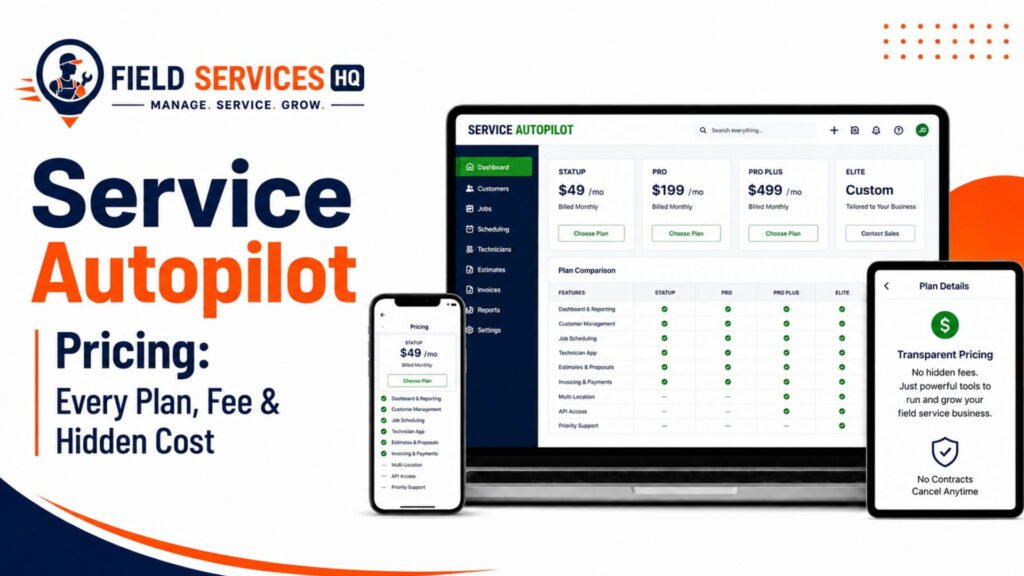
Direct answer: As of 2026, Service Autopilot publishes four tiers: Startup at $49/month, Pro at $199/month, Pro Plus at $499/month, and a custom-priced Elite tier, each also carrying an unpublished or separately listed sign-up fee, so the real first-month cost is higher than the advertised monthly rate.
| Plan | Monthly Price | Typical Sign-Up Fee | Best Suited For |
|---|---|---|---|
| Startup | $49/mo | Reported around $97 | Very small operations testing the platform; limited reporting |
| Pro | $199/mo | Reported around $97 | Growing crews needing job costing and route optimization |
| Pro Plus | $499/mo | Reported around $247 | Multi-crew businesses needing automation and custom reporting |
| Elite | Custom pricing | Custom | Larger operations needing full customization and dedicated support |
Beyond the listed plan price, budget for commonly billed add-ons like QuickBooks integration and route optimization modules (on some tiers), and onboarding or setup assistance, which one implementation partner quoted at $250 per hour for screen-share setup or several thousand dollars for a multi-day onboarding package. For the full list of Service Autopilot add-ons and hidden fees, see our detailed Service Autopilot pricing breakdown.
To put Service Autopilot’s starting price in perspective, it is generally higher than some direct competitors’ entry-level plans: Jobber starts around $39/month and Connecteam around $29/month , and Housecall Pro starts around $79/month and RealGreen’s entry point roughly matches Service Autopilot’s Pro tier at $199/month .
Is Service Autopilot Worth the Cost?
Potential ROI: For a company with 6+ crews, the value proposition of Service Autopilot hinges on labor efficiency and route optimization justifying the subscription cost, which for many businesses they will. Even if direct labor already comprises 25% to 40% of revenue , improving utilization by even a small amount through less drive time or overtime, enabled by route optimization and smart crew scheduling, could well pay for a $199 to $499/month subscription in the first month for a business with six figures or more in monthly recurring revenue.
FHQ calculations: Using back-of-the-envelope math, if automation saves your crews 30 minutes per day of unproductive driving in a 5-day workweek, that equals 2.5 hours of saved driving per crew per week. At a fully loaded crew cost of roughly $35 to $50 per hour (wages + overhead), that is $87 to $125 per crew per week or $375 to $540 per crew per month in potential savings – enough to offset the Pro Plus plan cost for just three crews.
These are just example calculations to help put the value proposition into perspective, as actual time saved will depend on crews’ ability to adopt new behaviors around using the software. Similarly, your actual time saved using the software will depend on your actual labor costs, which for most lawn care companies are somewhere around 30% to 50% of revenue.
External benchmarks: Assuming a 10% to 14% net margin for a well-run lawn care business, labor is usually their largest lever to improve profitability, which is directly impacted by this software category – unlike many other categories of software a service business might buy.
What Lawn-Care Businesses Like About Service Autopilot
- The automation engine for recurring reminders, follow-ups, and review requests is seen as a real time-saver
- Chemical application tracking with compliance-ready logging is a good differentiator vs. generalist FSM platforms
- The dispatch board is consistently cited as one of the most intuitive screens in the product
- CRM depth, including lead scoring and win/loss tracking, is superior to what most competitors at this price point offer
- GPS-based property measurement aids estimation for simpler accounts
What Lawn-Care Businesses Don’t Like About Service Autopilot
- The mobile app is the biggest source of complaints, with issues around bugs, synchronization, and dated UI
- The learning curve is steeper than expected; multiple reviewers cited 2-4 weeks to learn the basics
- Customer service gets mixed reviews, with some citing response delays and issues around cancellations and billing
- Additional costs around add-ons (QuickBooks sync, route optimization on some tiers) increase effective cost above the listed price
- Some longtime users noted the interface feels dated vs. newer, mobile-first competitors
Service Autopilot Limitations & Disqualifiers
Service Autopilot is likely not the right fit if any of the following are true:
- You are a solo operator or two-person crew without significant recurring account volume
- Technicians on your team prioritize mobility and modern mobile UX over depth in back-office processes
- Your team primarily works on design-build or installation work with few recurring maintenance accounts
- You require a free trial to evaluate the software, as Service Autopilot does not offer one
- You have a small team and cannot justify the cost of both a monthly subscription and the sign-up fee
Service Autopilot vs Alternatives for Lawn Care
| Platform | Starting Price | Best For |
|---|---|---|
| Service Autopilot | $49/mo + sign-up fee | Recurring lawn care/landscaping with chemical tracking needs |
| Jobber | ~$39/mo | Small to mid-size service businesses wanting a simpler, faster app experience |
| Housecall Pro | ~$79/mo | Multi-trade service businesses wanting strong scheduling and payments |
| RealGreen (by WorkWave) | ~$199/mo | Green-industry-specific businesses wanting deep lawn/landscape features |
Every platform on this list trades off differently between price, mobile experience, and lawn-care-specific depth. If Service Autopilot’s mobile limitations or pricing structure are a dealbreaker, our full Service Autopilot alternatives comparison walks through each option in more depth, including which trades and business sizes each one suits best.
Who Should Use Service Autopilot?
Service Autopilot is best suited for lawn care and landscape maintenance companies with 3 or more crews, significant recurring revenue, and/or who apply fertilizer, herbicide, or pesticide and need to track documented usage for state compliance. The software is also well suited for companies that provide more than one seasonal service (such as snow removal) who wish to avoid the hassle of using different software for different seasons of the year.
Who Should Not Use Service Autopilot?
Service Autopilot is probably not a good fit for solo operators, very small crews, or companies that do not have significant recurring revenue. Businesses for whom mobile app performance is a concern may want to carefully consider the documented mobile app issues before choosing Service Autopilot, due to the importance of mobile performance in the service sector.
Service Autopilot Lawn-Care Fit Scorecard
| Factor | Score (1-5) | Notes |
|---|---|---|
| Recurring service scheduling | 5 | Purpose-built for route-based recurring service |
| Chemical/compliance tracking | 5 | Strongest in its category for this specific need |
| Job costing & profitability visibility | 4 | Strong, but gated behind Pro/Pro Plus tiers |
| Mobile app reliability | 2 | Consistent weak point across independent reviews |
| Ease of onboarding | 2 | Real learning curve reported by multiple users |
| Pricing transparency | 3 | Tiers are published, but add-ons and fees are not always clear upfront |
| Customer support | 2 | Frequent complaints about responsiveness |
| Overall fit for growing lawn care crews (3-25) | 4 | Strong fit if mobile limitations are acceptable |
Should Your Lawn-Care Business Choose Service Autopilot?
Walk through these questions before making the decision:
- Do you have 3 or more crews with significant recurring revenue? If not, consider returning to this option at a later growth stage.
- Do you apply chemicals that require documented compliance tracking? If yes, this is a major strength in Service Autopilot’s favor.
- Can your team members handle a serious learning curve in the onboarding process? If your office staff is already overworked, budget additional time for this.
- Is mobile field experience a make-or-break priority for your operations? If so, request a mobile app demo and trial with an actual crew for several days.
- Can your budget truly absorb the Pro or Pro Plus plan plus add-ons, or are you likely to underfund it based on the “starting at” pricing? Underfunding this software by any amount is the single biggest mistake I see service companies make when considering FSM platforms.
Final Verdict
Service Autopilot has earned its reputation as a mid-range to high-end lawn care and landscape maintenance software by excelling with larger companies (not tiny startups) that have intensive residential routing needs and/or utilize chemical treatments requiring detailed compliance tracking. Its main weaknesses are in the smallest end of the market and companies needing mobile-first field operations where ease of use is paramount.
The software’s heavy automation and deep CRM capabilities are rare at this price point, with the mobile application and steeper learning curve being the primary downsides. If your company falls into the “strong consideration” category in the tables above, I strongly recommend scheduling a demo. For teams that don’t fit this profile, exploring the Service Autopilot alternatives page would be a better use of time than trying to convince yourself this software is right for you.
Frequently Asked Questions
Is Service Autopilot good for a small lawn care business?
Service Autopilot can work for a small lawn care business, but it is generally a better fit once a company has at least 3 crews and a meaningful base of recurring accounts. Solo operators and very small crews often find the cost, sign-up fee, and onboarding time disproportionate to the benefit at that stage, and a simpler, lower-cost tool is usually more practical until the business scales.
How much does Service Autopilot cost for a lawn care business?
As of 2026, Service Autopilot’s published pricing starts at $49/month for the Startup plan, $199/month for Pro, and $499/month for Pro Plus, with a custom-priced Elite tier for larger operations. Each plan also carries a separate sign-up fee, and features like QuickBooks integration or route optimization are sometimes billed as add-ons, so the effective monthly cost is often higher than the headline number.
Does Service Autopilot track chemical and pesticide applications?
Yes. Service Autopilot logs the product applied, quantity used, lot number, and treated area for each chemical application, which supports the documentation many states require for pesticide and fertilizer application reporting. This is one of the platform’s most distinctive strengths compared to general-purpose field service software that lacks this capability entirely.
Is the Service Autopilot mobile app reliable for field crews?
The mobile app is the most consistently criticized part of Service Autopilot in independent reviews, with users reporting syncing problems between the mobile app and web platform, bugs, and slower performance compared to newer competitors. Businesses that depend heavily on a smooth field-side mobile experience should test it directly with a working crew before committing to a plan.
What is the difference between Service Autopilot’s Pro and Pro Plus plans for lawn care?
The Pro plan, at $199/month, adds employee and asset tracking, job costing, and route optimization on top of the Startup plan’s basics. The Pro Plus plan, at $499/month, layers on deeper automation and full custom reporting. For lawn care businesses that want real profitability visibility by route, crew, or service type, Pro Plus is typically where that becomes fully available.
Does Service Autopilot offer a free trial for lawn care companies?
No. Service Autopilot does not currently offer a free trial, which means businesses generally need to commit to a paid plan, including the sign-up fee, before fully testing the platform in daily operations. Requesting a live demo before purchasing is the practical way to evaluate fit given the lack of a trial period.
How does Service Autopilot compare to Jobber for lawn care businesses?
Jobber generally starts at a lower monthly price (around $39/month) and is frequently cited as having a simpler, more modern mobile experience, while Service Autopilot offers deeper lawn-care-specific functionality, particularly chemical application tracking and more advanced automation. The better choice depends on whether chemical compliance tracking and automation depth outweigh the value of a smoother day-to-day mobile experience for your crews.
Can Service Autopilot help a lawn care business track job profitability?
Yes, but full profitability tracking, including job costing, labor cost analysis, and custom reporting by route or service type, is concentrated in the Pro and Pro Plus tiers rather than the entry-level Startup plan. Businesses evaluating the platform specifically for profitability visibility should budget for at least the Pro tier rather than assuming the base plan covers it.
What size lawn care business is the best fit for Service Autopilot?
Service Autopilot is generally the strongest fit for lawn care and landscape maintenance businesses running 6 to 25 or more crews with substantial recurring residential or light commercial revenue. This is the range where automation, route optimization, and chemical compliance tracking tend to generate enough operational savings to clearly justify the subscription and onboarding investment.
Is Service Autopilot worth it compared to hiring more office staff instead?
For businesses with enough recurring volume, software-driven automation for scheduling, invoicing, and follow-ups often costs less per month than an additional office hire while handling a comparable administrative workload, though it requires an upfront time investment to configure and learn. The right comparison depends on your current administrative bottleneck, current labor costs in your market, and how much of that work is genuinely repetitive versus judgment-based.
Affiliate Disclosure: Field Services HQ may earn a commission if you purchase software through links on this page, at no additional cost to you. This does not influence our evaluation criteria, testing, ratings, or conclusions. We only recommend tools we believe can genuinely benefit field service businesses.
Sources & Evidence
- National Association of Landscape Professionals, citing IBISWorld data, via Service Autopilot 2026 Lawn & Landscaping State of the Industry
- Grand View Research, U.S. landscaping services market projections
- U.S. Bureau of Labor Statistics, Occupational Employment and Wage Statistics (OEWS), landscaping and groundskeeping workers, via bls.gov
- National Association of Realtors and National Association of Landscape Professionals, joint remodeling impact report, cited via ConsumerAffairs Landscaping Industry Statistics
- Workyard, Landscaping Industry Facts and Statistics 2026
- Service Autopilot published pricing and plan comparison pages, verified 2026, cited via ITQlick and SoftwareFinder
- User reviews via Capterra, SelectHub, and the Apple App Store
- National Association of Landscape Professionals, landscapeprofessionals.org