Simpro for Refrigeration Contractors: Features, Pricing, Integrations and Fit (2026 Guide)
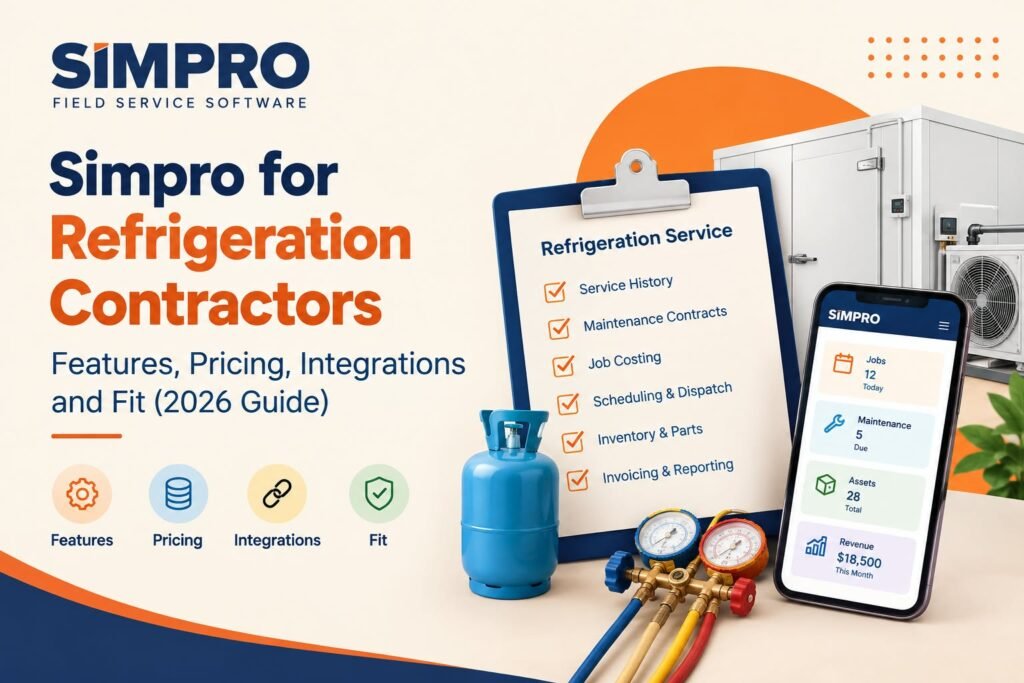
Refrigeration work is not regular HVAC with a colder box. You have walk-ins that fail on a Saturday night, supermarket racks with dozens of circuits, ice machines nobody wants to own, and, as of 2026, a federal leak repair rulebook that expects you to prove what you did and when. When I look at field service software for a refrigeration company, I do not ask whether it has scheduling and invoicing. Almost everything does. I ask whether it can hold equipment history, drive maintenance contracts, and keep paper trails clean enough to survive a compliance question.
Simpro is a name that comes up often in that conversation, especially for contractors who run service, maintenance, and project work together. This guide walks through what Simpro does well, where refrigeration contractors should test it hard before signing, how it connects to accounting tools, and how to decide if it fits your shop. If you want a second angle on the topic, our deeper breakdown of Simpro for refrigeration contractors covers the product from a slightly different direction.
Quick Answer: Is Simpro Good for Refrigeration Businesses?
Simpro is a strong fit for refrigeration contractors that run recurring maintenance contracts, track equipment by asset, and need job costing across service and project work. It is a weaker fit for very small one-truck shops or teams that need a built-in refrigerant log out of the box. Confirm refrigerant tracking in a live demo before you buy.
That answer is about 50 words on purpose, and the rest of this article explains the reasoning behind it.
Key Takeaways
- Simpro is a general trade and field service platform, not a refrigeration-only product. Its strengths (assets, maintenance planning, job costing, mobile) map well to refrigeration service.
- EPA leak repair rules for HFC appliances with a full charge of 15 pounds or more began applying on January 1, 2026, which raises the value of good asset and service records.
- Simpro lists native accounting integrations such as QuickBooks and Xero, and Sage can be connected through Zapier.
- Simpro pricing is quote based, so total cost depends on users, modules, and implementation scope.
- Before buying, test refrigerant tracking, leak rate documentation, and equipment-level history using your own real data.
- Smaller shops may do better with a lighter tool; larger or multi-branch teams get more from Simpro’s depth.
What Simpro Is and How It Handles Refrigeration Work
What Simpro Actually Does
Simpro describes itself as field service management software for service, maintenance, and project contractors. It covers quoting, scheduling, job management, inventory, invoicing, and reporting in one connected system, with a mobile app for technicians. Third-party listings such as SourceForge’s Simpro profile also categorize it under CMMS, equipment maintenance, and HVAC software, which tells you how buyers use it in practice.
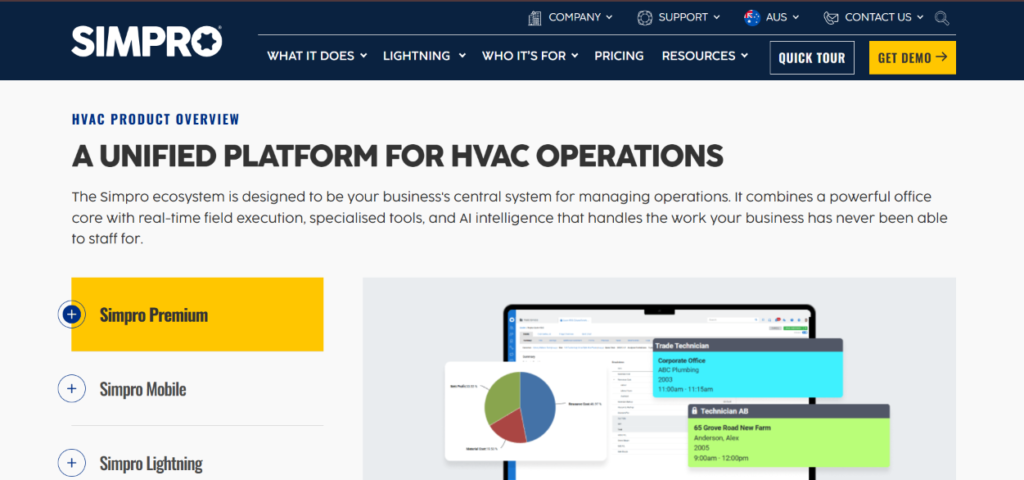
Simpro’s own HVAC software page emphasizes managing complex workflows, accurate job costing, recurring maintenance, and asset testing from the mobile app. Refrigeration contractors are usually grouped under that HVACR umbrella, so the same toolset applies.
Where the Refrigeration Fit Comes From
Simpro does not ship a “refrigeration edition” that I could find in its public materials. The fit comes from four building blocks that refrigeration companies lean on every day:
- Asset-level records. Each walk-in, rack, ice machine, or reach-in case can be treated as an asset with its own service history.
- Maintenance planning. Recurring preventive maintenance visits are generated from contracts instead of someone’s memory.
- Job costing. Labor, parts, and subcontractor costs roll up against each job, which matters when a “quick” compressor swap turns into a three-day callback.
- Mobile workflows. Technicians capture time, notes, photos, and forms on site, then the office invoices from the same record.
Simpro’s HVAC apps guide also points to a maintenance planner, digital forms, SMS updates, and data feeds as part of the platform. That is the raw material. How well it works for you depends on how you configure it.
Why Refrigeration Contractors Need More Than a Generic Job App
The 2026 Leak Repair Rules Raise the Documentation Bar
This is the part many software comparisons skip. Under the EPA’s Emissions Reduction and Reclamation (ER&R) rule, owners, operators, and certified technicians must comply with leak repair requirements for appliances holding 15 pounds or more of HFC refrigerant (or certain HFC substitutes with a GWP above 53), starting January 1, 2026. The agency lays this out in its leak repair fact sheet, and the broader program is summarized in the EPA ER&R overview.
In practical terms, that means:
- You calculate the leak rate whenever refrigerant is added.
- Leak rate thresholds depend on the appliance sector. Law firm summaries of the final rule list 20% for commercial refrigeration and 30% for industrial process refrigeration, as noted by Beveridge & Diamond.
- Repairs generally need to happen within 30 days of the addition that revealed the problem, with verification testing afterward.
- Systems with 1,500 pounds or more of refrigerant face automatic leak detection requirements.
- Records need to be kept, and compliance guides commonly cite a three-year minimum retention period.
Residential and light commercial air conditioning and heat pumps are not covered by these provisions, according to the International Code Council’s summary. Commercial refrigeration is squarely in scope.
The same ICC summary notes that starting January 1, 2029, servicing and repair of supermarket systems, refrigerated transport, and automatic commercial ice makers must use reclaimed HFCs. If you service those categories, your parts and refrigerant purchasing workflow will need to evolve too.
For context on why EPA cares, an EIA press release quoting the agency says EPA estimates leak repair and automatic leak detection requirements will save $19.5 million in 2026 by reducing the need to replace leaked refrigerant. Compliance is a cost, but leaking refrigerant is a cost too.
One caution: rules and compliance dates in this area get revised. EPA changed parts of its Technology Transitions regulations in 2026, so always check the agency’s current guidance rather than relying on any article, including this one. Also remember that your federal technician obligations under Section 608 still apply alongside the newer HFC provisions.
The Labor Picture Makes Efficiency Non-Negotiable
The U.S. Bureau of Labor Statistics reports about 440,900 jobs for heating, air conditioning, and refrigeration mechanics and installers in 2025, a median pay of $61,010 per year, and projected growth of 11% from 2025 to 2035, labeled much faster than average. BLS also projects about 40,600 openings each year over the decade.
Read that as a business owner: skilled technicians are in demand, they are expensive, and they are hard to replace. Every hour a technician spends hunting for a service history, rewriting notes at night, or driving to the wrong site is an hour you paid for and did not bill. Software will not solve hiring, but it can protect the capacity you already have.
Simpro Features That Matter for Refrigeration Contractors
Asset Records and Service History
In my experience, the single most valuable thing a refrigeration company can build is a clean equipment register. Model, serial number, refrigerant type, charge size, install date, location, warranty, and service history all belong in one place. When a technician opens a job for a failing walk-in, they should see the last three visits before they leave the truck.
Simpro supports asset tracking and service history, and Simpro Mobile is positioned for viewing job and asset history in the field. Whether it holds every refrigeration-specific field you want is a configuration question, which I cover below.
Maintenance Planning and Service Contracts
Preventive maintenance is where refrigeration companies build predictable revenue. Condenser coil cleaning, door gasket checks, defrost cycle checks, and refrigerant leak inspections are all schedule-driven. Simpro’s maintenance planner is designed to turn contracts into scheduled visits so nothing quietly drops off the calendar.
The practical test is simple. Load ten real customers with a mix of monthly, quarterly, and annual visits and see if the system generates the work correctly. If it does, you have just replaced a spreadsheet and a lot of worry.
Scheduling, Dispatch, and Mobile Access
Emergency calls are the heart of refrigeration. A failed cooler means spoiled product and an angry store manager, so dispatch has to account for technician skills, parts on the truck, and travel time. Simpro offers scheduling and dispatch tools, plus fleet and asset tracking through Simtrac, which can help match the right technician to the right job.
I always tell owners to evaluate dispatch with a bad day scenario, not a good one. Put three urgent calls in at once and watch how fast your dispatcher can reshuffle the board.
Quoting, Job Costing, and Invoicing
Refrigeration repair quotes can swing wildly. A compressor replacement might include recovery, evacuation, a new filter drier, a refrigerant charge, and a return visit. Simpro supports quoting, takeoffs from plans for project work, and job costing so you can see actual margin against estimate. That matters a great deal on installation and retrofit projects, where profit often disappears in change orders nobody tracked.
Inventory and Parts
Compressors, contactors, fan motors, TXVs, and drier cores add up. Inventory tracking by truck and warehouse reduces the “I thought we had one” problem. Simpro includes inventory and purchasing tools, and its integration partner list references wholesale supplier connections, which can reduce manual re-keying of purchase data. Check which suppliers are supported in your region.
Reporting
Good reporting answers questions like: Which customers are unprofitable? Which technicians have the highest callback rate? Which contracts are underpriced? Reviews on Capterra frequently praise Simpro’s reporting on job costs and profitability, although individual experience varies with setup quality.
Refrigeration-Specific Gaps to Test Before You Buy
I want to be direct here, because this is where buying decisions go wrong. Simpro is a general trade platform. From the public materials I reviewed, I could not confirm a dedicated, built-in refrigerant ledger that automatically calculates leak rates under the EPA rule. That does not mean you cannot do it. It means you should verify.
Ask the Simpro team to show you these in a live demo with your data:
- Refrigerant tracking by asset. Can you record refrigerant added, recovered, and reclaimed per appliance, with dates and technician names?
- Leak rate calculation. Is it automated, or do you capture inputs in custom fields or forms and calculate elsewhere?
- Repair and verification records. Can a technician attach an initial and follow-up verification test to the same asset history?
- Retrieval speed. If an auditor or customer asks for three years of records on one rack, how fast can you produce them?
- Automatic leak detection data. If you service large systems, can alarm events be tied to work orders?
Simpro supports customizable fields, forms, asset tracking, and compliance-related features according to listings such as Tekpon, so there is a reasonable path. Just do not assume. If the answer is “custom forms plus a report,” decide whether your team will actually keep that process disciplined.
Simpro Integrations: QuickBooks, Xero, Sage, and Zapier
Most refrigeration companies already have an accounting system, and they do not want to rebuild finance to adopt field software. Integration quality can make or break the rollout. One thing I see often is a company that buys field software, then still re-enters invoices into accounting for months because nobody scoped the sync properly.
Simpro and QuickBooks
Simpro lists QuickBooks as an accounting integration, describing a flow of customer, supplier, and contractor invoice data from Simpro into QuickBooks with a few clicks, as outlined on its QuickBooks integration page. For most North American refrigeration contractors, this is the most common pairing. Our guide to connecting Simpro and QuickBooks goes deeper on setup considerations like chart of accounts mapping and tax codes.
Simpro and Xero
Simpro’s Xero integration page says it can transfer invoices, timesheets, customers, suppliers, and contractor details, and that payments can be applied in Simpro and sent to Xero or brought back. Xero is more common outside North America, but plenty of US and Canadian shops use it. If that is you, read our walkthrough on Simpro and Xero before you finalize your setup.
Simpro and Sage
I could not find a native Sage integration in Simpro’s public integration list, which highlights QuickBooks, Xero, and MYOB. However, Zapier lists a connection between Sage Accounting and Simpro, so a middleware route exists. If Sage is your accounting platform, our article on Simpro and Sage explains the options and tradeoffs. Confirm current support with Simpro before committing.
Simpro and Zapier
Zapier markets connections to more than 9,000 apps, and it offers Simpro triggers and actions. That opens lighter automation: pushing new customers to a CRM, sending a notification when a job completes, or logging data to a spreadsheet. The Simpro and Zapier guide covers practical automations worth building first.
A word of caution from an implementation perspective. Middleware is useful, but each added connection is another place for data to break, and someone has to own it. Start with the native accounting sync, then add automations only where they remove real work.
Simpro Pricing and Total Cost of Ownership
Simpro does not publish a simple public price list. Its own materials describe customized pricing based on team size, features, and workflow complexity. I will not guess numbers, because any figure I print would be unsupported. Here is how to think about cost instead.
| Cost Area | How It Typically Works | Question to Ask |
|---|---|---|
| Software licenses | Quote based, influenced by users and modules | Which modules are included, and what is billed per user? |
| Implementation | Setup, configuration, and data import | Is onboarding included or separate? |
| Data migration | Customers, assets, contracts, inventory | Who cleans and loads the data? |
| Training | Documentation, live online, webinars, in-person options | What training is included, and how long does support last? |
| Integrations | Accounting sync, middleware, supplier connections | Are any connectors billed separately? |
| Ongoing support | Included with purchase per some directory listings | What are support hours and response targets? |
The takeaway: ask for a written quote that itemizes licenses, onboarding, migration, and any add-ons, and compare it against the total first-year cost, not just the monthly subscription. Quote-based pricing usually favors businesses with enough volume to justify setup effort, so a very small shop should weigh that carefully.
On ROI, I avoid promising numbers. A fair way to estimate value is to track four things before and after: invoice turnaround time, callbacks per hundred jobs, billable hours per technician, and missed maintenance visits. If those do not move after six months, the software is not paying for itself.
Simpro Compared With Other Options
Refrigeration contractors typically weigh Simpro against general field service tools, HVAC-focused platforms, and lightweight job apps. This table frames the comparison by business type rather than naming a “winner.”
| Business Situation | Simpro Fit | Alternative to Consider |
|---|---|---|
| Multi-technician team with service, maintenance, and project work | Strong | Other full FSM platforms |
| Heavy preventive maintenance contract book | Strong | CMMS-leaning platforms |
| One to three techs, mostly reactive calls | Possible, may be more than needed | Lightweight job management apps |
| Primarily residential comfort cooling | Possible | HVAC-specific residential platforms |
| Strict refrigerant compliance as top priority | Verify in demo | Tools with dedicated refrigerant logs |
| Already invested in ERP, wanting deep customization | Verify integrations and API | ERP-connected FSM, such as ERPNext-based builds |
I do not recommend any platform just because it is popular. The right answer depends on your contract mix, your technician count, and how much process discipline you can maintain.
Who Simpro Fits Best (and Who Should Look Elsewhere)
Good Fit
- Refrigeration and HVACR companies with five or more technicians and a mix of service calls, maintenance agreements, and installs.
- Contractors who need job costing that follows a job from quote to final invoice.
- Teams with multiple branches or entities that need consolidated reporting.
- Businesses willing to invest in setup, data cleanup, and training.
Weaker Fit
- Very small shops that mostly need quotes and invoices.
- Companies expecting a ready-made refrigerant compliance module without configuration.
- Teams that will not designate a person to own the system after launch.
- Businesses that need very low upfront cost and fast, self-serve setup.
Step-by-Step: How to Evaluate Simpro for Your Refrigeration Business
- Write down your top five pain points. Examples: lost service history, late invoices, missed PM visits, weak job costing, messy refrigerant records.
- Build a small test dataset. Ten customers, thirty assets, five maintenance contracts, and a handful of parts.
- Request a demo using that dataset. Skip the generic tour.
- Run three scenarios. An emergency walk-in failure, a quarterly PM route, and a compressor replacement with a return visit.
- Test refrigerant record keeping. Add refrigerant to an appliance, document the leak rate inputs, then retrieve the history.
- Test the accounting sync. Push one invoice and one payment through your accounting system and reconcile them.
- Get a written, itemized quote. Include onboarding, migration, and support.
- Talk to a reference customer in a similar trade. Ask what they wish they had configured differently.
- Pilot with a small group. One dispatcher, two technicians, and one office admin for a few weeks.
- Decide with numbers. Compare against your baseline metrics, not gut feeling.
Common Mistakes Refrigeration Contractors Make
- Buying on feature lists. A long feature list says little about whether your technicians will actually use it.
- Skipping data cleanup. Importing messy equipment records just moves the mess into a new system.
- Ignoring the compliance workflow. If refrigerant records live in a separate notebook, you have not solved the problem.
- Underestimating training. Technicians who feel slowed down by the app will find workarounds.
- No internal owner. Someone must manage templates, fields, and permissions after go-live.
- Over-customizing on day one. Start simple, then refine once real usage shows what you need.
- Forgetting the accounting handoff. Decide in advance how invoices, payments, and taxes flow.
Best Practices for a Smooth Rollout
A practical approach is to roll out in phases. Start with customers, assets, and scheduling. Add maintenance contracts next. Layer in inventory and purchasing after the team is comfortable. Accounting integration should be tested early, but switched on only after your chart of accounts and tax settings are reviewed by your bookkeeper.
I have found that technician adoption improves when forms are short. Three required fields that always get filled beat twelve that get skipped. Build your refrigerant record form around what you need to calculate leak rates and prove repairs, and nothing more. Review it after a month and tighten it up.
Finally, set a few simple reports to look at weekly: open jobs by age, maintenance visits due, callbacks, and unbilled work. Small, repeated reviews catch problems far earlier than a big quarterly clean-up.
Industry-Specific Recommendations
Commercial Refrigeration Service
Focus on asset-level history and fast dispatch. Make sure each walk-in, reach-in, and display case is its own asset with refrigerant type and charge size recorded. Those two fields tell you quickly whether the 15-pound threshold applies.
Supermarket and Grocery Accounts
Rack systems and multi-store accounts need site hierarchies, multiple contacts, and clear service level expectations. Look closely at how Simpro handles multi-site customers, recurring PMs by store, and consolidated invoicing. Plan ahead for the 2029 reclaimed refrigerant requirement for supermarket systems by tracking refrigerant sources now.
Walk-Ins, Cold Storage, and Ice Machines
These are usually high-volume, repeat-service assets. Structure your maintenance planner around seasonal loads (summer heat strains condensers) and tie ice machine sanitation visits to dated checklists.
Installation and Retrofit Projects
For project work, rely on quotes, takeoffs, and job costing. Track change orders carefully. Retrofits driven by refrigerant phase-down are likely to grow, and margin visibility on those jobs is where a platform like Simpro tends to earn its cost.
Decision Checklist: Is Simpro Right for You?
- We run recurring maintenance contracts and want them scheduled automatically.
- We service equipment where asset history changes how we diagnose problems.
- We need job costing across service and project work.
- We have an internal person who can own the system.
- Our accounting platform (QuickBooks, Xero, or another) can be connected and tested.
- We confirmed in a demo how refrigerant records and leak rate data will be captured.
- We have a written quote covering licenses, onboarding, migration, and support.
- We are willing to run a pilot before rolling out company-wide.
If you checked most of these, Simpro deserves a serious look. If you checked only a few, a simpler tool may serve you better for now.
Frequently Asked Questions About Simpro for Refrigeration
Is Simpro good for refrigeration companies?
Simpro is a good fit for refrigeration companies that need asset tracking, maintenance planning, job costing, and mobile workflows in one system. It is not refrigeration-specific, so confirm refrigerant record keeping in a demo with your own equipment data before committing.
Does Simpro have a built-in refrigerant log?
I could not confirm a dedicated, built-in refrigerant log in Simpro’s public materials. Many contractors capture refrigerant data through custom fields, forms, and asset records. Ask Simpro to demonstrate your exact workflow, including leak rate inputs and repair verification records.
Do the EPA leak repair rules apply to my refrigeration equipment?
They apply to appliances with a full charge of 15 pounds or more of an HFC refrigerant or qualifying substitute with a GWP above 53, starting January 1, 2026. Residential and light commercial air conditioning and heat pumps are excluded. Check EPA’s leak repair fact sheet for your specific appliance type.
How much does Simpro cost?
Simpro uses quote-based pricing that depends on team size, modules, and workflow complexity, so there is no single public price. Ask for an itemized quote covering licenses, onboarding, data migration, training, and support, then compare total first-year cost.
Does Simpro integrate with QuickBooks?
Yes. Simpro lists QuickBooks as an accounting integration that sends customer, supplier, and contractor invoice data from Simpro to QuickBooks. Test the sync with a few live invoices and payments before switching it on for everyone. See our guide on Simpro and QuickBooks for setup details.
Does Simpro work with Xero?
Yes. Simpro’s Xero integration supports transferring invoices, timesheets, customers, suppliers, and contractor details, and payments can move in either direction. Our article on Simpro and Xero covers what to prepare before connecting.
Can I connect Simpro to Sage?
A Sage connection is available through Zapier according to Zapier’s listing, but Simpro’s own integration list highlights QuickBooks, Xero, and MYOB. Confirm current support with Simpro, and read our breakdown of Simpro and Sage before deciding.
What can I automate with Simpro and Zapier?
Common automations include syncing new customers to a CRM, notifying staff when jobs complete, and logging job data to spreadsheets. Start with one or two workflows that remove repetitive work, and review our Simpro and Zapier guide for ideas.
Is Simpro too big for a small refrigeration business?
It can be. Teams with only one to three technicians and mostly reactive calls may find Simpro heavier than needed, especially with quote-based pricing and setup effort. Small shops with growing maintenance contracts and project work may still benefit if they plan implementation carefully.
How long does it take to implement Simpro?
Timelines vary with data volume, number of users, and how many modules you activate. A phased rollout, starting with customers, assets, and scheduling, then adding maintenance contracts, inventory, and accounting, tends to work better than switching everything on at once. Ask Simpro for a project plan specific to your company.
Final Thoughts
Simpro can be a solid operating backbone for a refrigeration contractor that has outgrown spreadsheets and basic job apps. Its asset records, maintenance planning, job costing, and accounting integrations line up with the way service-heavy shops actually make money. The tradeoffs are real, though: quote-based pricing, implementation effort, and the need to verify refrigerant tracking against the 2026 EPA requirements instead of assuming it works.
My advice is to decide based on your own data. Run the demo with your equipment list, test one real maintenance route, and push a real invoice through your accounting system. If the platform handles those three things cleanly, you are probably looking at a good match.
If you are still comparing options, explore the field service software resources, calculators, and templates at Field Services HQ to build a shortlist, estimate your costs, and prepare the questions to ask vendors. Our related guides on Simpro and QuickBooks and Simpro and Zapier are good next reads once you know your accounting setup.