Simpro Preventive Maintenance & Service Agreements: The Complete Breakdown
Quick Answer
Yes, Simpro has preventive maintenance tools, built primarily around its Maintenance Planner add-on and recurring job scheduling in Simpro Enterprise. It lets field service businesses set service levels, schedule recurring maintenance jobs, track asset history, and manage service agreements from one system. It works best for mid-size to larger commercial contractors managing multiple sites and contracts.

Key Takeaways
- Simpro’s preventive maintenance capability is split between native recurring jobs (available in most Simpro tiers) and the more advanced Maintenance Planner add-on, which requires Simpro Enterprise.
- Service agreements in Simpro are managed through service levels tied to customer assets and sites, not a single standalone “contracts module.”
- The strongest fit is commercial HVAC, commercial electrical, commercial plumbing, and fire and security contractors running recurring, asset-heavy maintenance programs across multiple locations.
- Smaller residential-focused businesses often find the setup heavier than they need and may get more value from a simpler recurring job workflow.
- Preventive maintenance programs, when run consistently, are associated with meaningfully lower unplanned downtime and maintenance costs, according to Department of Energy research, which is exactly the value case Simpro is built to support operationally.
What “Preventive Maintenance” Actually Means Inside Simpro
Before getting into features, it helps to define the term the way Simpro’s own system treats it, because this trips up a lot of contractors evaluating the platform.
Simpro’s preventive maintenance workflow combines customer assets, service levels, contracts, and recurring jobs rather than relying on one standalone PM screen. Customer contracts can be used to track the commercial side of ongoing services, while assets and service levels help define what equipment needs to be maintained and how often. Maintenance Planner adds more advanced scheduling and testing capabilities for businesses managing larger volumes of recurring, asset-driven maintenance work.
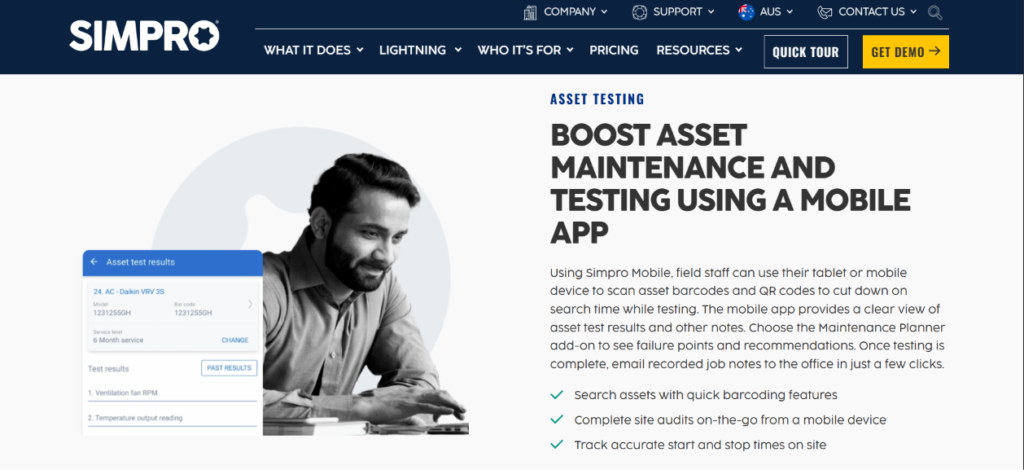
The workflow can therefore be viewed through four connected components:
Assets: Store information about equipment, including maintenance and testing history.
Customer contracts: Help manage the commercial side of ongoing service agreements, including contract dates, value, and rates.
Service levels: Define the maintenance or testing requirements associated with assets.
Recurring jobs and Maintenance Planner: Turn those maintenance requirements into scheduled field work.
In my experience working with contractors who adopt Simpro specifically for maintenance work, the businesses that get the most value are the ones that set up assets and service levels properly before they start scheduling. Skipping that step and just creating recurring jobs manually works for a handful of accounts, but it falls apart once you’re managing dozens or hundreds of maintenance contracts.
Service Agreements and Service Levels in Simpro
Simpro can manage service agreements through customer contracts, while Maintenance Planner connects those contracts with customer assets and service levels to support recurring preventive maintenance work. A contract can include its own rates, dates, value, and other commercial details, while service levels define the maintenance requirements associated with assets.
This structure also gives contractors a way to separate operational maintenance data from commercial contract data. For example, the asset record can retain equipment and testing information, while the customer contract can track contract-specific rates and value. Simpro’s documentation also states that contracts can be selected when creating jobs, invoices, recurring jobs, or recurring invoices.
- How frequently an asset needs to be tested or serviced (monthly, quarterly, annually, or a custom interval)
- What labor, materials, and billable items are included as part of that service
- What technician qualifications are required
- What happens when a test fails (a failure point can automatically trigger a follow-up job or quote)
This structure matters for how you should think about contracts. If you sell tiered service agreements, for example a basic annual inspection plan versus a premium plan with quarterly visits and priority response, you set those up as different service levels rather than as separate “contract types.” That distinction is one of the more common points of confusion I see when contractors move from a simpler platform or from spreadsheets into Simpro.
For a closer look at how the underlying asset and scheduling structure works day to day, our detailed walkthrough of Simpro’s preventive maintenance workflow covers the setup process step by step.
Simpro Maintenance Planner: Core Features
Maintenance Planner is the add-on most directly associated with preventive maintenance in Simpro, and it requires a Simpro Enterprise build. Simpro describes Maintenance Planner as being designed for businesses handling high volumes of asset-driven jobs and multiple service-level agreements. Its current feature set includes scheduling assets and recurring jobs, assigning technicians, recording maintenance details and test results, and providing reporting on asset information, test dates, and contract information.
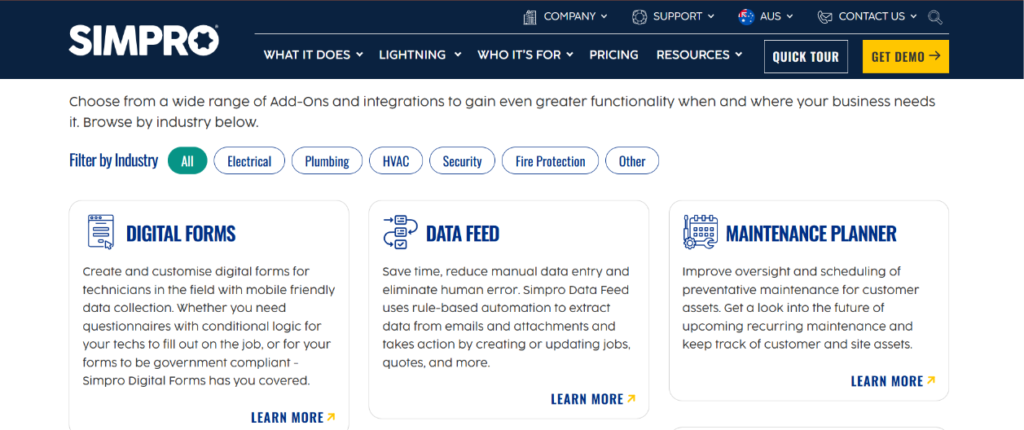
It is designed for businesses handling a high volume of asset-driven jobs across multiple service-level agreements, and its core functionality includes:
Service level management. You define exactly which assets need to be tested, at what frequency, and by whom.
Failure point tracking. When a technician records a failed test in the field, Maintenance Planner can automatically flag it and route it toward a rectification job or quote, rather than relying on someone catching it manually afterward.
Flat-rate pre-builds. You can create combination pricing (labor plus materials, or either on its own) that appears as a single billable line item on jobs, quotes, and invoices. This keeps pricing consistent across technicians and sites instead of every tech quoting a job differently.
Automatic data population. Customer details, site information, and asset specifications populate automatically into new maintenance jobs and quotes, cutting down on double entry.
Centralized reporting. Simpro says Maintenance Planner provides access to up-to-date asset reports, test dates, and contract information, while its asset-maintenance tools can also track contract activity, costs, and income.
This is a genuinely useful structure for contractors managing service-level agreements at scale, but it is worth being direct about the tradeoff: Maintenance Planner adds real setup complexity, and it is gated behind the Enterprise tier, which is Simpro’s highest pricing level. A two- or three-technician residential outfit doing occasional maintenance visits is unlikely to need it.
Simpro has also continued expanding Maintenance Planner in 2026. In its Q1 2026 product update, the company announced a Defect Management Module that lets technicians record asset defects in the field and track those defects from open through completion in a centralized record.
Setting Up a Preventive Maintenance Program in Simpro: Step by Step
A practical approach, based on how implementations typically go for field service businesses, looks like this:
- Build out your site and asset records first. Every piece of equipment you’re responsible for maintaining should exist as an asset tied to the correct customer site, with accurate install dates and specifications.This foundation matters because Simpro’s Maintenance Planner relies on relationships between customer assets, sites, service levels, failure points, pre-builds, and preferred technicians. Simpro’s own documentation describes these relationships as core parts of setting up Maintenance Planner.
- Define your service levels. Decide on inspection frequency, included labor and materials, and any failure-point logic before you touch scheduling.
- Create flat-rate pre-builds for standard services. This keeps technician quoting and invoicing consistent, which matters a lot once you have more than a couple of techs in the field.
- Set up recurring jobs against each service level. This is what actually populates your dispatch calendar.
- Assign preferred technicians where relevant. Some maintenance work, particularly commercial refrigeration or fire system testing, benefits from continuity of the same technician visiting a site.
- Test the failure-point workflow before going live. Run through what happens when a technician marks an inspection item as failed, and confirm the follow-up job or quote generates the way you expect.
- Review reporting monthly. Use the maintenance dashboard to catch upcoming test dates and lapsed service levels before customers do.
One issue I commonly see is businesses rushing step 1 and step 2 to get to scheduling faster. That shortcut tends to create data cleanup work six months later, once asset records are inconsistent across sites.
Simpro Pricing for Maintenance and Service Agreement Tools
Simpro does not publish flat, self-serve pricing; quotes are based on business size, tier, and add-ons like Maintenance Planner. The general shape of the tiers relevant to preventive maintenance work is summarized below. Always confirm current figures directly with Simpro, since software pricing changes over time.
| Tier | General Fit | Preventive Maintenance Capability |
|---|---|---|
| Simpro Essentials / Premium | Small to mid-size contractors | Native recurring jobs; no Maintenance Planner |
| Simpro Enterprise | Mid-size to large contractors, multi-site operations | Recurring jobs plus access to the Maintenance Planner add-on |
| Maintenance Planner (add-on) | Businesses with high volumes of asset-driven maintenance and multiple service-level agreements | Service levels, failure points, flat-rate pre-builds, centralized maintenance reporting |
The main pricing takeaway is that basic recurring maintenance scheduling is available without the top tier, but the full service-level and failure-point workflow that most people mean when they ask “does Simpro have preventive maintenance” in a commercial, contract-driven sense is tied to Simpro Enterprise plus the Maintenance Planner add-on. That is a meaningful cost and implementation step up, and it should be sized against how much recurring maintenance revenue you’re actually managing before you commit to it.
Why Preventive Maintenance Programs Matter Operationally
It’s worth stepping back from the software for a moment, because the business case for running a structured preventive maintenance program, in Simpro or anywhere else, is well documented outside the software industry itself.
The U.S. Department of Energy’s Better Buildings & Better Plants Initiative says operations and maintenance programs targeting energy and water efficiency are estimated to save 5% to 20% on energy bills without significant capital investment. The guidance specifically identifies preventive maintenance as part of the broader operations and maintenance approach used to improve equipment performance and efficiency.
For trades that manage genuinely large equipment bases, particularly commercial HVAC and refrigeration, that demand is only growing. The Bureau of Labor Statistics projects employment of heating, air conditioning, and refrigeration mechanics and installers will grow 8 percent from 2024 to 2034, much faster than the average for all occupations, which points to sustained demand for the kind of recurring maintenance work Simpro’s service-level structure is built to manage.
Simpro vs. Manual and Spreadsheet-Based Maintenance Tracking
| Factor | Spreadsheets / Manual Tracking | Simpro (with Maintenance Planner) |
|---|---|---|
| Setup time | Minimal | Moderate to significant |
| Scales past ~50 maintenance contracts | Poorly, becomes error-prone | Built for this volume |
| Automatic follow-up on failed tests | Manual, easy to miss | Can auto-generate jobs or quotes |
| Pricing consistency across technicians | Depends entirely on discipline | Enforced through flat-rate pre-builds |
| Reporting on upcoming test dates | Manual pulls, often stale | Centralized dashboard |
| Best suited for | Very small operations, low contract volume | Growing or established contractors with multi-site agreements |
If you’re running fewer than a couple dozen maintenance agreements, a well-organized spreadsheet with calendar reminders can genuinely be enough, and there’s no shame in that. The case for moving to Simpro’s structured approach usually becomes clear once missed service dates, inconsistent technician pricing, or lost visibility into contract profitability start costing more than the software would.
Industry-Specific Applications
Simpro for Commercial HVAC Preventive Maintenance
HVAC is arguably the trade where Simpro’s service-level and asset structure fits most naturally, because commercial HVAC maintenance almost always involves recurring, seasonally driven inspections across multiple pieces of equipment per site. Filter changes, refrigerant checks, and coil cleaning schedules map well onto service levels, and failure-point tracking is useful when a unit fails an inspection mid-contract. Our breakdown of Simpro for commercial HVAC goes deeper into how HVAC contractors specifically configure asset records and maintenance agreements.
The U.S. Department of Energy estimates that organizations can save 5% to 20% annually on energy bills through effective operations and maintenance practices, making preventive HVAC maintenance relevant not only for equipment reliability but also for building energy efficiency.
Simpro for Commercial Electrical Service Agreements
Commercial electrical maintenance, including periodic panel inspections, thermal imaging checks, and compliance testing, benefits from the same asset-and-service-level structure, particularly for contractors managing testing schedules across multiple commercial properties for the same client. Our guide to Simpro for commercial electrical work covers how electrical contractors typically structure recurring inspection contracts inside the platform.
Simpro for Commercial Plumbing Maintenance Contracts
Plumbing maintenance agreements, backflow testing, water heater inspections, grease trap servicing, tend to be less asset-dense than HVAC but still benefit from Simpro’s recurring job scheduling and failure-point workflow, especially for multi-location commercial clients like restaurant groups or property management companies. This resource on Simpro for commercial plumbing walks through how that setup typically looks.
Simpro for Fire and Security Service Agreements
Fire and security is where compliance-driven scheduling matters most, since inspection frequency isn’t just a business decision, it’s a regulatory one. NFPA 25 sets minimum inspection, testing, and maintenance frequencies for water-based fire protection systems, and jurisdictions across the country adopt it directly into building and fire codes.NFPA 25 outlines the responsibilities of the building owner or owner’s representative, detailing specific care requirements for various systems through separate chapters, including fire sprinkler systems, standpipes and hose systems, private fire service mains, fire pumps, and water storage tanks. A service-level structure that can enforce fixed testing intervals and automatically flag failures is a genuine operational fit for that kind of compliance work. Our resource on Simpro for fire and security covers how fire and security contractors typically configure this in practice.
NFPA’s current materials continue to identify inspection, testing, and maintenance frequencies as core requirements for water-based fire protection systems, covering equipment such as sprinkler systems, standpipes and hose systems, private fire service mains, fire pumps, and water storage tanks.
Common Mistakes Businesses Make with Simpro Preventive Maintenance
- Building recurring jobs before asset records are clean. This creates scheduling based on inaccurate equipment data, which shows up later as missed or duplicated visits.
- Treating Maintenance Planner as optional polish rather than core infrastructure. For businesses with real contract volume, skipping it often means falling back on manual tracking anyway, which defeats the purpose of the software investment.
- Not training technicians on failure-point entry. If techs don’t consistently mark failed tests correctly in the field, the automated follow-up workflow never triggers, and the business loses the main advantage of the system. Simpro’s mobile documentation shows that technicians can record asset test results and, when Maintenance Planner is being used, record failure points and recommendations directly during field testing.
- Underpricing service agreements because flat-rate pre-builds weren’t set up. Inconsistent quoting across technicians is one of the more common profitability leaks in recurring maintenance work.
- Ignoring the reporting dashboard. Contractors often set up the scheduling side well but never build the habit of reviewing upcoming test dates and lapsed agreements monthly, which is where a lot of the software’s value actually sits.
Best Practices for Getting the Most from Simpro Service Agreements
- Standardize service levels across similar equipment types before customizing per customer, then customize only where genuinely necessary.
- Assign preferred technicians to recurring accounts where continuity of knowledge matters, particularly for complex commercial systems.
- Review failure-point data quarterly to spot patterns, such as a specific asset type failing tests repeatedly, which may point to a bigger sales or replacement opportunity.
- Use the centralized maintenance reporting to forecast recurring revenue, not just to track upcoming jobs.
- Revisit pricing on flat-rate pre-builds at least annually, since labor and material costs shift and a pre-build set two years ago may no longer reflect real costs.
Does Simpro Have Preventive Maintenance? Reviewing the Limitations
To answer the search question directly: yes, but the depth of that capability depends heavily on which tier and add-ons you’re using. A few honest limitations worth weighing:
- The full service-level and failure-point workflow is gated behind Simpro Enterprise and the Maintenance Planner add-on, which represents a real cost and complexity jump from base Simpro.
- Initial setup, particularly getting asset and site data accurate, takes real time and is easy to underestimate during onboarding.
- Smaller, residential-focused businesses with low maintenance contract volume may find the structure more than they need.
- Like most FSM platforms, the system is only as good as the data discipline behind it; automated failure-point routing does not help if technicians aren’t recording results consistently in the field.
None of this means Simpro is a poor fit for maintenance-driven businesses. It means the decision to adopt the full preventive maintenance workflow should be based on actual contract volume and complexity, not just a general sense that “the software should handle this.”
Frequently Asked Questions
Does Simpro have preventive maintenance built in?
Yes. Simpro supports preventive maintenance through recurring jobs available across most tiers, plus a more advanced service-level and failure-point workflow through the Maintenance Planner add-on, which requires Simpro Enterprise.
What is Simpro Maintenance Planner?
Maintenance Planner is an add-on for Simpro Enterprise designed for businesses managing high volumes of asset-driven maintenance work. It handles service levels, failure point tracking, flat-rate pricing pre-builds, and centralized maintenance reporting across customer sites.
Do I need Simpro Enterprise to run preventive maintenance?
Not for basic recurring maintenance scheduling, which is available on lower tiers. You need Simpro Enterprise specifically to access Maintenance Planner, which provides the fuller service-level, failure-point, and reporting workflow most contractors mean when they ask about preventive maintenance in Simpro.
How does Simpro handle service agreements?
Simpro can manage service agreements through customer contracts, while Maintenance Planner connects contracts with customer assets and service levels for preventive maintenance workflows. Customer contracts can contain details such as start and end dates, contract value, contract-specific rates, and other commercial information, while service levels define maintenance requirements for assets.
Can Simpro automatically schedule recurring maintenance jobs?
Yes. Once assets and service levels are configured, Simpro can generate recurring jobs based on the defined frequency, and Maintenance Planner adds the ability to automatically route failed inspections toward follow-up jobs or quotes.
What trades benefit most from Simpro’s preventive maintenance tools?
Commercial HVAC, commercial electrical, commercial plumbing, and fire and security contractors tend to see the strongest fit, since these trades typically manage recurring, asset-heavy maintenance work across multiple sites and often have compliance-driven inspection schedules.
Is Simpro good for small businesses that just want basic maintenance reminders?
It can work, but the full preventive maintenance and service-level workflow is built for scale. A small contractor with a handful of maintenance accounts may find native recurring jobs sufficient without needing the Enterprise tier or Maintenance Planner add-on.
How does Simpro pricing work for preventive maintenance features?
Simpro does not publish flat pricing publicly. The Maintenance Planner add-on requires a Simpro Enterprise subscription, and pricing is quoted based on business size and configuration, so it’s worth confirming current numbers directly with Simpro before budgeting.
What’s the biggest mistake businesses make setting up preventive maintenance in Simpro?
Building recurring jobs and service levels before cleaning up asset and site data. Inaccurate equipment records lead to inaccurate scheduling, which tends to surface as missed or duplicated maintenance visits months into using the system.
Does Simpro integrate failure tracking into maintenance workflows?
Yes, through Maintenance Planner’s failure point functionality, which can automatically flag a failed inspection and route it toward a follow-up job or quote, assuming technicians record the failure correctly in the field.
Final Thoughts
Simpro’s preventive maintenance capability is real and, for the right kind of business, genuinely strong: the combination of asset records, service levels, and Maintenance Planner’s failure-point automation covers most of what a commercial maintenance-driven contractor actually needs. The catch is that the depth most people are really asking about sits behind Simpro Enterprise and an add-on, not in the base product, and getting value out of it depends on doing the unglamorous setup work of clean asset data and consistent service levels before you start scheduling.
If you’re weighing Simpro against other tools for a specific trade, our HVAC, electrical, plumbing, and fire and security guides linked above go further into how each of those industries typically configures the platform for their own maintenance and compliance requirements.