Simpro Quoting and Estimating: A Complete Breakdown for Field Service Businesses
Getting a quote out the door quickly, and getting it right, is one of the biggest levers a field service business has on profitability. I’ve worked with enough contractors and service operations teams to know that quoting is rarely the flashy part of the business, but it is almost always where deals are won or lost and where margin quietly disappears. Simpro’s quoting and estimating tools are one of the more established options for trades and project-based service businesses trying to fix that problem, so it’s worth a detailed look at how the feature actually works, where it holds up, and where it doesn’t.
This breakdown covers how Simpro quoting and estimating functions in practice, what a simpro quoting review should actually evaluate, whether Simpro has real quoting depth or just a basic form builder, and how the feature fits into a broader service operation once a quote is accepted.

Quick Answer
Simpro’s quoting and estimating functionality is integrated into its field service management platform, allowing businesses to create quotes using their price book, labour, materials and other cost information. Quotes can then move through the approval process and into the operational workflow once accepted, helping businesses maintain continuity between estimating, job management and invoicing.
Key Takeaways
- Simpro quoting pulls pricing from a centralized catalog and price book, which reduces manual re-pricing errors on every job.
- Quotes can include multiple pricing tiers or options, which is useful for larger residential and light commercial proposals.
- An accepted quote converts directly into a job, keeping labor, materials, and margin data intact from estimate to invoice.
- Simpro’s Takeoffs add-on lets estimators measure directly from uploaded plans, which speeds up construction and project-based estimating.
- Pricing is not publish a standard public price for it quoting and estimating functionality , so business should confirm current pricing and included features directly with Simpro .
- The learning curve is real. Businesses coming from spreadsheets or a lighter tool like Jobber should budget real time for setup and training.
What Is Simpro Quoting and Estimating
Simpro quoting and estimating is the module inside the Simpro field service and construction management platform that handles the process of pricing a job, presenting it to a customer, and tracking it through to acceptance. It is not a bolt-on form builder. It sits inside the same system as scheduling, dispatching, inventory, and invoicing, which means a quote is built using the same price book and cost data that will eventually drive job costing and billing.
That distinction matters more than it sounds. In a lot of smaller quoting tools, the quote is essentially a static document. In Simpro, the quote is a live record tied to catalog items, labor rates, and supplier pricing, so when a technician or estimator builds a proposal, they are pulling from the same numbers the business uses everywhere else. When the customer accepts, that data flows into the job rather than getting rebuilt from scratch.
How Simpro’s Quoting Feature Works
Building a Quote
A quote in Simpro starts from a customer record, either an existing one or a new lead. From there, an estimator adds catalog items, labor, and materials, either individually or through pre-built templates for common job types. For service and project businesses that quote the same categories of work repeatedly, such as a panel upgrade, a system install, or a maintenance package, templates cut a meaningful amount of time out of the process because the estimator is adjusting quantities and specifics rather than starting from a blank page.
Pricing is drawn from Simpro’s price book, which stores labor rates, material costs, and markups. This is one of the more useful parts of the system in my experience: because pricing lives centrally, a rate change (a new material cost from a supplier, for example) updates future quotes automatically instead of relying on someone remembering to update a spreadsheet formula.
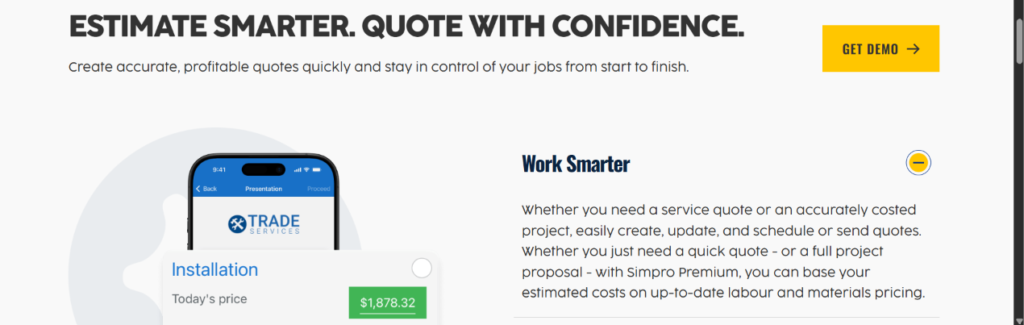
Simpro’s current estimating documentation says quotes can use catalogue items, take-off templates and pre-builds, while estimated costs can be based on up-to-date labour and materials pricing. This gives estimators a more structured starting point than building each quote from scratch.
Quote Templates and Customization
Simpro supports customizable quote and proposal templates, so a service call quote can look different from a full project proposal, with company branding, terms, and formatting adjusted for the type of work.Simpro also supports multiple options within quotes, allowing businesses to present customers with different pricing or scope choices within the same proposal. This can be useful for service businesses that want to present different levels of work rather than limiting the customer to a single fixed option.
A Simpro case study of Foster Plumbing reported that its estimators reached up to 25 large TI blueprinted bids per week after using Simpro, supported by prebuilds and a 7,000+ item catalogue with multiple vendor pricing.
Approvals and Digital Sign-Off
Once a quote has been created and sent, Simpro provides a workflow for tracking the quote through its sales and approval stages. Customers can review and approve quotes electronically, helping businesses keep the approval record connected to the original quote rather than relying solely on separate email or paper records. For field service businesses, this closes a gap that costs real revenue: quotes that get verbally approved on-site but never formally logged, leaving a technician to start work before there’s a signed record covering scope and price.
Simpro currently supports online quote acceptance, after which an accepted quote can be converted into a single or recurring job. This keeps customer approval connected to the operational workflow rather than leaving the approval as a separate document or email trail.
Simpro Estimating Capabilities
Job Costing and Pricebook
Simpro connects estimating with job costing by allowing businesses to establish expected labour and material costs during the estimating process and compare those figures with costs recorded as work progresses. Labour information, purchasing and inventory activity can therefore contribute to the job’s overall cost picture after a quote has been converted into a job.This is where Simpro moves past being a quoting tool and starts functioning more like a light job costing system.
For businesses running project-based work, such as electrical, roofing, or larger install jobs, this visibility is genuinely useful. It’s the difference between finding out a job lost money weeks later during reconciliation and catching a cost overrun while there’s still time to manage it. If your business is also evaluating how inventory data feeds into that costing accuracy, it’s worth reviewing how Simpro handles inventory management alongside quoting, since stock costs and quote accuracy are directly connected.
For construction and project-based estimating, Simpro Takeoffs is designed to help estimators measure quantities directly from digital plans. Estimators can upload plans, set a measurement scale and take measurements from drawings, helping turn plan-based measurements into quantities that can be used during the estimating process. This functionality is particularly relevant for trades where material requirements depend on measured areas, lengths or quantities rather than a standard service price.

Simpro Takeoffs can connect drawings directly with Simpro quotes, jobs and projects, with material estimates and associated fit times feeding into project cost centres. The tool also includes features such as plan uploads and symbol recognition.
Simpro states that businesses can track estimated costs against actual spending and adjust budgets as work progresses, including labour and material costs.
Progressive Invoicing Tied to Estimates
Because the quote, job, and invoice share the same underlying data, Simpro supports progressive or milestone-based invoicing off a single estimate, which matters for larger projects billed in stages rather than a single invoice at completion. This reduces the double entry that happens when a project’s billing schedule lives in a spreadsheet separate from the original estimate.
Does Simpro Have Quoting?
Yes. Simpro includes quoting functionality within its field service management platform. Businesses can create quotes using pricing and catalogue information, add labour and materials, present different pricing options to customers, and manage quotes through the approval process. Once a quote is accepted, the information can continue into the job-management workflow, helping businesses maintain continuity between the original estimate and the work that follows.
Simpro Quoting Review: Strengths and Weaknesses
A fair simpro quoting review has to weigh what the tool does well against where it creates friction, because Simpro is not the simplest quoting tool on the market and it isn’t trying to be.
Independent customer-review platforms provide additional context when evaluating Simpro as a wider field service management platform. Simpro has a 4.2/5 rating on G2 and a 4.0/5 rating on Capterra. These ratings represent overall user experiences with Simpro rather than the quoting and estimating functionality alone, so they should be treated as broader indicators of customer satisfaction rather than a specific rating for quoting.
What Works Well
- Centralized pricing. Labor rates, material costs, and markups live in one price book, so quotes stay consistent across estimators and locations.
- Quote-to-job continuity. An accepted quote becomes the job record, carrying over budgeted costs without manual re-entry.
- Multi-option quotes. Tiered or optional pricing within a single quote supports upselling without building three separate documents.
- Takeoffs for project estimating. Plan-based measurement speeds up quantity takeoffs for construction-adjacent trades.
- Job costing visibility. Budgeted versus actual cost tracking gives real-time insight into whether a job is staying profitable, not just whether it was quoted correctly.
Where It Falls Short
User reviews provide some useful context around areas businesses should evaluate before adopting Simpro. Feedback on third-party review platforms includes comments about the platform’s learning curve and interface complexity, while some users also identify customization and reporting as areas that may require additional evaluation. These concerns do not necessarily apply to every business, but they are relevant when assessing whether Simpro’s quoting and estimating workflow matches the way a particular team operates.
If reporting depth is a priority for your business, it’s worth reading through how Simpro’s reporting and business intelligence tools actually perform before assuming the built-in reports will cover your needs.
Simpro Quoting vs Manual or Spreadsheet Estimating
For a business still quoting out of spreadsheets or a generic document template, the comparison isn’t really about features. It’s about where errors and delays creep in.
| Factor | Simpro Quoting | Spreadsheet or Manual Quoting |
|---|---|---|
| Pricing consistency | Centralized price book helps standardize pricing across quotes | Relies on someone manually updating formulas or templates |
| Approval tracking | Digital status tracking and e-signature | Email threads, verbal approvals, or paper sign-off |
| Quote-to-job handoff | Accepted quote information can flow into the job workflow | Manual re-entry into scheduling or job files |
| Multi-option proposals | Built-in tiered pricing support | Requires building separate documents per option |
| Job costing tie-in | Budgeted vs. actual costs tracked automatically | Requires a separate costing process or spreadsheet |
| Setup effort | Meaningful upfront configuration and training | Minimal setup, but scales poorly |
| Best fit | Growing service or project businesses with multiple estimators | Very small operations doing a handful of quotes a month |
The honest takeaway here: spreadsheets aren’t wrong for a one- or two-person operation doing a small volume of quotes. The problems show up at scale, when multiple people are quoting, prices are changing, and nobody has full visibility into which quotes are outstanding, approved, or forgotten in someone’s inbox.
Industry-Specific Recommendations
HVAC
HVAC businesses juggling service calls alongside installation quoting benefit from Simpro’s ability to separate quick service estimates from full system replacement proposals, while keeping equipment and labor pricing centralized. Maintenance agreement quoting can also connect directly to ongoing preventive maintenance scheduling once a customer signs on, which is worth understanding in more depth through Field Services HQ’s guide to Simpro’s preventive maintenance tools.
Plumbing
For plumbing businesses handling a mix of emergency calls and planned work like water heater replacements, having a fast, templated quote for common jobs alongside detailed estimating for larger repipe or remodel work covers both ends of the workflow without switching tools.
Electrical
Electrical contractors doing panel upgrades, service calls, and larger installation projects benefit most from the budgeted-versus-actual job costing tie-in, since material costs on electrical work can shift meaningfully between quote and completion.
Roofing
Roofing businesses doing measured, material-heavy estimates are a strong fit for the Takeoffs add-on, since quantity accuracy from a plan or aerial measurement has a direct impact on material ordering and margin.
Landscaping
For landscaping businesses running a mix of one-time projects and recurring seasonal contracts, quote-to-job continuity helps keep pricing consistent between the initial proposal and any recurring service agreement that follows.
Common Mistakes with Simpro Quoting and Estimating
- Skipping price book setup. Businesses that rush implementation and don’t fully build out labor rates and material costs end up manually overriding prices on every quote, which defeats the purpose of a centralized system.
- Not using templates. Rebuilding every quote from a blank slate wastes the time savings the platform is designed to provide.
- Ignoring approval tracking. Letting quotes sit in “sent” status without follow-up processes means opportunities quietly go cold.
- Underestimating training time. Assuming a team will pick up the interface intuitively often leads to inconsistent quoting practices between estimators.
- Treating quoting and job costing as separate steps. The real value of Simpro’s quoting module comes from feeding directly into job costing; businesses that export quotes elsewhere and manually rebuild job budgets lose that advantage.
Best Practices for Setting Up Simpro Quoting and Estimating
- Build out the price book before quoting a single job. Labor rates, material costs, and markups need to be accurate from day one, or every quote afterward inherits the same errors.
- Create templates for your most common job types first. Focus on the 20 percent of job categories that make up most of your quote volume.
- Standardize your approval workflow across estimators, including what counts as a follow-up trigger for quotes sitting in “sent” status too long.
- Use tiered or multi-option quoting for higher-value residential and light commercial work where a customer decision, rather than a yes-or-no answer, tends to increase average job value.
- Review budgeted-versus-actual cost data regularly, not just at job close, so cost overruns can be caught and addressed mid-job.
How Quoting Connects to the Rest of the Operation
Simpro connects quoting with the wider field service workflow rather than treating a quote as a standalone document. Quote information can continue into job management after acceptance, while labour, purchasing and inventory activity can contribute to job-cost tracking. This creates a connected workflow between estimating, job execution and billing.. If you’re evaluating Simpro’s quoting and estimating tools specifically, it’s worth mapping out how quotes will flow into inventory reservations and reporting dashboards before implementation, rather than treating quoting as a standalone decision.
Is Simpro Quoting and Estimating Right for Your Business?
From an implementation perspective, Simpro tends to make the most sense for service and project businesses with multiple estimators, a real volume of quotes each month, and a need for quote data to carry through into job costing and billing without manual re-entry. Electrical, plumbing, HVAC, roofing, and security businesses running a mix of service and project work are Simpro’s core fit.
It tends to make less sense for very small operations doing a low volume of simple quotes, businesses that need a highly customizable or unusually structured quoting workflow, or businesses that are price-sensitive and want transparent, self-serve pricing before committing to a demo. In those cases, a lighter tool with published pricing and a lower learning curve may be a better starting point, with a move to a more connected platform like Simpro once quote volume and complexity grow.
Frequently Asked Questions
Does Simpro have quoting and estimating built in?
Yes. Quoting and estimating is a core feature included in every Simpro pricing tier, not a separate add-on. It covers quote building from a centralized price book, multi-option proposals, digital approval tracking, and conversion of accepted quotes directly into jobs.
How does Simpro quoting differ from a basic quote builder?
Simpro’s quoting pulls from the same price book and cost data used across scheduling, inventory, and invoicing, so an accepted quote becomes a job without re-entering pricing or scope. A basic quote builder typically produces a standalone document that has to be manually transferred into a separate job or invoicing system.
Can Simpro create multiple pricing options within one quote?
Yes. Simpro supports presenting a customer with multiple pricing options in a single quote, such as tiered service packages or separate cost centers for different scopes of work, and the customer can choose which option to accept.
What is Simpro Takeoffs and do I need it for quoting?
Takeoffs is an add-on that lets estimators upload a plan, set a scale, and measure quantities directly from the drawing using symbol recognition. It’s most useful for construction-adjacent trades like roofing, fencing, and larger installation projects where material quantities are measured from plans. It is not required for standard service quoting.
How much does Simpro quoting and estimating cost?
Simpro does not publish pricing publicly, and quotes are provided directly by their sales team based on user count and selected tier. Third-party research generally places per-user monthly costs somewhere between $150 and $300, with enterprise pricing negotiated separately, though actual costs vary based on business size and add-ons.
Does an accepted Simpro quote automatically become a job?
Yes. When a customer approves a quote, Simpro converts it directly into a job record, carrying over the budgeted labor, materials, and pricing so the estimate becomes the basis for job costing and eventual invoicing.
Is Simpro quoting good for small service businesses?
It can be, but it’s built for businesses that need quoting connected to scheduling, inventory, and job costing rather than a lightweight standalone tool. Very small operations with a low quote volume may find simpler, lower-cost tools sufficient until their quoting needs grow more complex.
Does Simpro support digital quote approval and e-signature?
Yes. Simpro tracks quote status through the sales process and supports digital sign-off, allowing customers to approve quotes electronically rather than through email or verbal confirmation.
What are the main weaknesses in Simpro’s quoting and estimating tools?
The most commonly cited weaknesses are a cluttered interface with a real learning curve for new users, limited customization compared to some competitors, and native reporting that is often described as shallow relative to the data the platform holds, which pushes some businesses toward exporting data for deeper analysis.
How does Simpro estimating support job costing?
Simpro links estimating with job costing by allowing businesses to establish budgeted costs during the estimating process and compare them with actual costs recorded as the job progresses. Labour, purchasing and inventory-related costs can contribute to the actual cost of the job, helping businesses monitor how performance compares with the original estimate.
Final Thoughts
Quoting and estimating is one of those features that looks similar across most field service platforms on a spec sheet, but behaves very differently once you’re actually running quotes through it every day. Simpro’s version is built for businesses that want quoting tied directly into job costing, inventory, and scheduling rather than functioning as a standalone document generator, and that connectedness is really the whole value proposition. It comes with a real setup cost, both in time and in the learning curve for new users, and it isn’t the cheapest or simplest option on the market.
For a growing electrical, plumbing, HVAC, or project-based service business quoting a meaningful volume of work each month, that tradeoff tends to be worth it. For a very small operation doing a handful of quotes, it may be more platform than you need right now. Either way, the decision is worth making deliberately, based on how quoting connects to the rest of your operation, not just on how the quote template looks in a demo.
If you’re weighing Simpro against other platforms or trying to map out how quoting, inventory, and reporting should work together for your business, Field Services HQ has additional breakdowns covering each of these areas in more depth to help you make that decision with a fuller picture of the platform.