
Best Refrigerant Leak Detector for Trade Pros: Heated Diode and Infrared Models Compared
Some links on this page are affiliate links. If you buy through one, we may earn a commission at no extra cost to you. See our affiliate disclosure.

Quick answer: For most HVAC technicians, choose a heated diode detector for pinpointing and budget, or an infrared detector for fewer false alarms and longer sensor life. The Inficon D-TEK 3 lists the tightest sensitivity here, and the Elitech ILD-100H is the lowest-cost entry. Eight detectors are compared below.
Check the refrigerant list and the A2L marking, and note the sensor life before you buy.
Best Refrigerant Leak Detectors: 8 Models at a Glance
Eight detectors from Elitech, TopTes, Inficon, testo and Robinair. Tap a photo or a button to see the current price and listing details.
| Product | Best for | Price category | Named by | Buy |
|---|---|---|---|---|
 Elitech ILD-100H Heated Diode Refrigerant Leak Detector | The lowest-cost heated diode detector with a color screen | Budget | Elitech’s manual summary and a retailer page | Check price |
 TopTes RT-389 Rechargeable Refrigerant Leak Detector | A budget rechargeable detector with three alarm types | Budget | WC Safety and Misec | See details |
 Inficon TEK-Mate 705-202-G1 Heated Diode Refrigerant Leak Detector | An A2L certified heated diode detector from a leak detection specialist | Mid-range | Inficon data sheets | Compare options |
 testo 316-3 Refrigerant Leak Detector | A rugged heated diode detector with automatic zeroing | Mid-range | Testo and Instrumart | Shop now |
 Elitech ILD-200 Infrared Refrigerant Leak Detector | The lowest-cost infrared detector here | Mid-range | Elitech’s store page and a distributor sheet | View listing |
 Inficon D-TEK 3 Refrigerant Leak Detector | The premium infrared detector for A2L and mixed-refrigerant work | Premium | Inficon and Century Tool | Check availability |
 Robinair LD3 Economy Refrigerant Leak Detector | A US-made entry-level detector with three sensitivity levels | Mid-range | Robinair and OTC Tools | See current price |
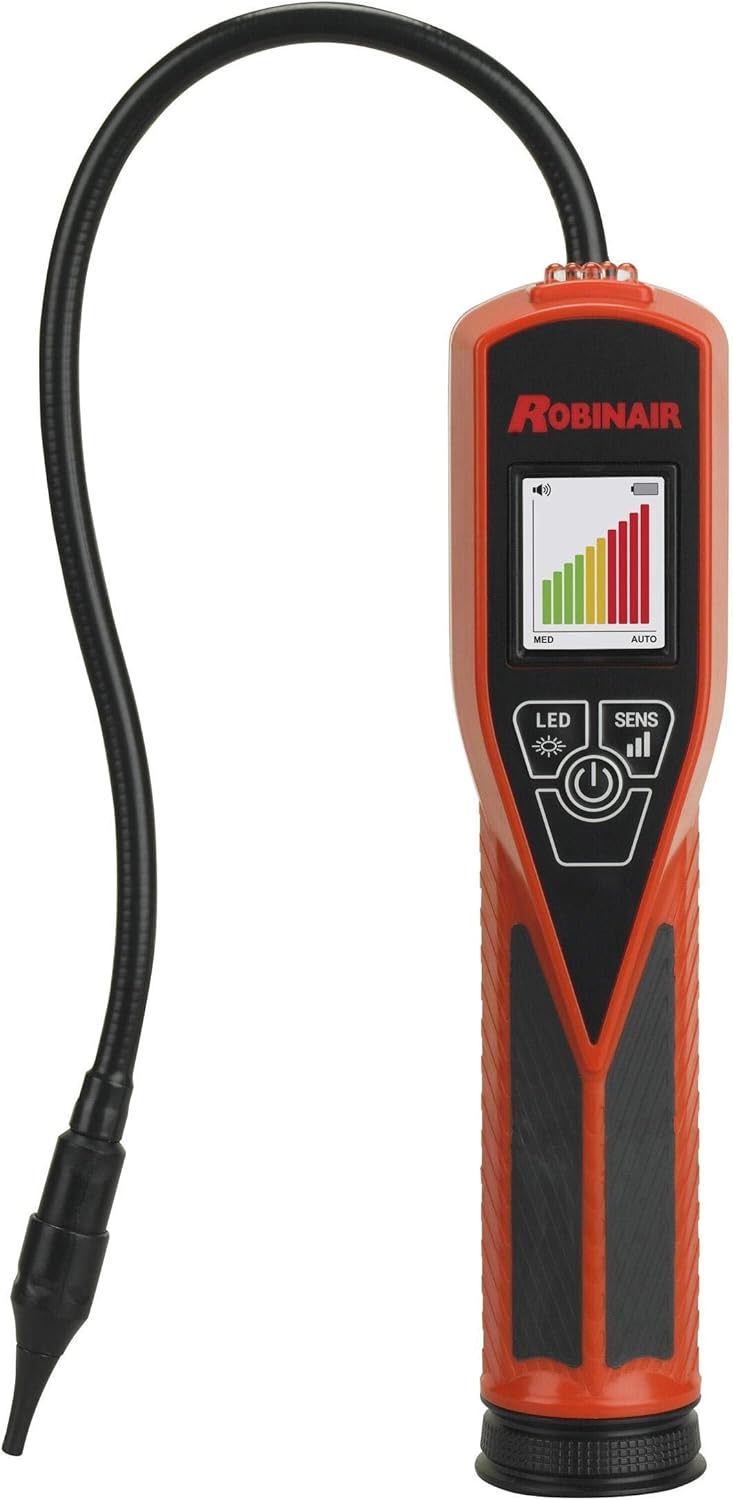 Robinair LD5 Select Refrigerant Leak Detector | A color-display Robinair for shops that want a bar graph | Premium | OTC Tools, Snap-on dealer page and Cool Tools | Open listing |
Price categories reflect the listing price when we checked: Budget is under $150, Mid-range is $150 to $350 and Premium is above $350. Prices vary by seller.

Which Refrigerant Leak Detector for Which Job (and Who Should Skip Each)
| If you need | Look at | What the sources say |
|---|---|---|
| The lowest-cost sensitive detector | Elitech ILD-100H | 0.1 oz per year, TFT screen (manual summary). |
| A rechargeable backup | TopTes RT-389 | Three alarm types, 14.5 inch probe (WC Safety, Misec). |
| A2L certified heated diode | Inficon TEK-Mate | A2L certified, 16 hour battery (Inficon). |
| Rugged, auto zeroing | testo 316-3 | Automatic zeroing, 0.15 oz per year (Testo). |
| Entry infrared | Elitech ILD-200 | Infrared, 0.14 oz per year (Elitech). |
| The tightest sensitivity and A2L | Inficon D-TEK 3 | 0.03 oz per year, A2L certified (Inficon, Century Tool). |
| A US-made basic unit | Robinair LD3 | Three sensitivity levels, sensor warranty (Robinair). |
| A color bar graph display | Robinair LD5 | Color bar graph, 4 AA (Snap-on dealer, OTC Tools). |
Who should skip each detector
| Product | Skip it if | Because |
|---|---|---|
| Elitech ILD-100H | You sweep large systems all day | Heated diode sensor wears out |
| TopTes RT-389 | You need certified A2L | No A2L marking found |
| Inficon TEK-Mate | You want a light rechargeable | D cells, 1.54 lb |
| testo 316-3 | You work on A2L systems | No A2L or HFO listing |
| Elitech ILD-200 | You want the tightest sensitivity | 0.14 oz per year |
| Inficon D-TEK 3 | You do light occasional checks | Highest price |
| Robinair LD3 | You want A2L certification | No A2L listing found |
| Robinair LD5 | You want lower published sensitivity | Same as LD3 |
Best Heated Diode and Semiconductor Leak Detectors
Good for pinpointing small leaks and for tight budgets.
Elitech ILD-100H Heated Diode Refrigerant Leak Detector
Best for: the lowest-cost heated diode detector with a color screen
Elitech ILD-100H Heated Diode Refrigerant Leak Detector
Price category: Budget
A rechargeable heated diode detector with a flexible probe, a TFT screen and three sensitivity levels up to 0.1 oz per year.
Check priceA manual summary lists three sensitivity levels with a maximum of 0.1 oz per year, an immediate response within 1 second, a built-in 3.7 V 3000 mAh lithium-ion battery and compliance with EN14624, SAE J2791 and SAE J2913 (Manuals Plus). A retailer page lists 6 hours of continuous use and a 1 year warranty (Desertcart).
Ferguson says heated diode sensors last roughly 100 to 300 hours, cost less upfront and carry a moderate false alarm risk (Ferguson), so plan for a replacement sensor if you use it daily. The manual summary lists the sensor type as IR even though the product is sold as heated diode, so treat that line as a labeling slip.
Spec sheet:
- Max sensitivity: 0.1 oz per year (Manuals Plus).
- Battery: 3.7 V 3000 mAh lithium-ion, 6 hours continuous (Desertcart).
- Warranty: 1 year (Manuals Plus).
What this means for you (general advice): A low-cost way to get a sensitive heated diode probe with a clear screen.
Fit and sizing: Flexible probe, three sensitivity levels.
Versions to check: Match ILD-100H in the title. Elitech sells several similar models.
Watch for: Heated diode sensors wear out; 1 year warranty.
Skip it if: you sweep large commercial systems all day.
TopTes RT-389 Rechargeable Refrigerant Leak Detector
Best for: A budget rechargeable detector with three alarm types
TopTes RT-389 Rechargeable Refrigerant Leak Detector
Price category: Budget
A rechargeable semiconductor detector with a 14.5 inch gooseneck, three sensitivity modes and sound, visual and vibration alarms.
See detailsWC Safety lists three sensitivity modes, three alarm types and coverage of CFC, HCFC, HFC, HFO and hydrocarbon refrigerants at about 271 g (WC Safety). Misec lists a semiconductor sensor, 0.1 oz per year sensitivity, a 14.5 inch probe, USB-C charging and an 8 hour battery (Misec).
WC Safety notes this is a newer model with limited public review history (WC Safety), and we found no A2L marking or sensor life figure from the maker. General advice: treat it as a backup or light-duty unit until you have your own history with it.
Spec sheet:
- Sensor: semiconductor, 0.1 oz per year (Misec).
- Probe: 14.5 inch gooseneck (Misec).
- Alarms: sound, visual, vibration (WC Safety).
What this means for you (general advice): Three sensitivity modes let you start broad and narrow down to the leak.
Fit and sizing: Rechargeable, light and compact.
Versions to check: Match RT-389 in the title. TopTes also sells combustible gas models.
Watch for: Limited track record, no A2L marking found.
Skip it if: you need a certified A2L detector.
Inficon TEK-Mate 705-202-G1 Heated Diode Refrigerant Leak Detector
Best for: an A2L certified heated diode detector from a leak detection specialist
Inficon TEK-Mate 705-202-G1 Heated Diode Refrigerant Leak Detector
Price category: Mid-range
A two D-cell heated diode detector with a 15 inch probe, A2L certification and a two year over-the-counter warranty.
Compare optionsThe Inficon sheet lists a heated diode sensor, a 15 inch probe, 1.54 lb weight, a minimum sensitivity of 0.25 oz per year (0.07 oz per year under EN14624), A2L certification and two D alkaline batteries good for 16 hours (Inficon sheet). A second Inficon document lists compatible refrigerants and the same 0.25 oz per year figure (Inficon sheet).
Inficon backs it with a two-year over-the-counter warranty (Inficon sheet). The 0.25 oz per year headline number is looser than the infrared or newer models below, so read the EN14624 figure when comparing.
Spec sheet:
- Sensitivity: 0.25 oz per year, 0.07 under EN14624 (Inficon sheet).
- Battery: 2 D cells, 16 hours (Inficon sheet).
- Certification: A2L (Inficon sheet).
What this means for you (general advice): A familiar, simple heated diode tool that also covers A2L jobs.
Fit and sizing: Long probe, D-cell power.
Versions to check: Match 705-202-G1 in the title.
Watch for: Heavier than rechargeable models, sensitivity figure is looser.
Skip it if: you want a lighter rechargeable unit.
testo 316-3 Refrigerant Leak Detector
Best for: A rugged heated diode detector with automatic zeroing
testo 316-3 Refrigerant Leak Detector
Price category: Mid-range
A heated diode detector with 0.15 oz per year sensitivity, automatic zeroing and a field-replaceable sensor.
Shop nowTesto lists a sensitivity of 4 g per year (0.15 oz per year), 16 hours of battery on two D cells and a sensor life of about 80 to 100 hours, roughly one year of normal use (Testo). The Instrumart datasheet adds a heated diode sensor, automatic zeroing, a 1 lb weight and a 2 year warranty (Instrumart).
The refrigerant list covers R22, R134a, R404A, R410A, R507, R438A and all CFCs, HCFCs and HFCs (Testo). It does not name HFOs or A2L refrigerants, so confirm with Testo if you service R32 or R454B.
Spec sheet:
- Sensitivity: 0.15 oz per year (Testo).
- Sensor life: about 80 to 100 hours (Testo).
- Battery: 2 D cells, 16 hours (Testo).
What this means for you (general advice): Automatic zeroing lets you work in a room that already smells of refrigerant.
Fit and sizing: Replaceable sensor head, carrying case.
Versions to check: Match 316-3 in the title.
Watch for: No A2L or HFO listing, short sensor life figure.
Skip it if: you work mainly on A2L systems.
Best Infrared Leak Detectors
Longer sensor life and fewer false alarms around other chemicals.
Elitech ILD-200 Infrared Refrigerant Leak Detector
Best for: the lowest-cost infrared detector here
Elitech ILD-200 Infrared Refrigerant Leak Detector
Price category: Mid-range
A rechargeable infrared detector with three sensitivity levels, a TFT screen and a 10 year sensor life claim.
View listingElitech’s store page lists an infrared sensor, three sensitivity levels with a maximum of 0.14 oz per year and a TFT screen, with 6 hours of detection after a 4 hour charge on a 3.78 V 3000 mAh battery (Elitech store). A distributor sheet lists an operating range of -10 to 52 degrees Celsius and a weight of 415 g (General Tech).
The 10 year sensor life is a maker claim in the product title. Ferguson says infrared sensors can last up to about 10 years, but also says the probe must keep moving because holding still lets the unit recalibrate and stop alarming (Ferguson). HVAC School makes the same trade-off point about pinpointing (HVAC School).
Spec sheet:
- Max sensitivity: 0.14 oz per year (Elitech store).
- Battery: 6 hours after a 4 hour charge (Elitech store).
- Weight: 415 g (General Tech).
What this means for you (general advice): Fewer false alarms from background chemicals than a heated diode, at a lower price than most infrared tools.
Fit and sizing: Rechargeable, TFT screen, earphone jack.
Versions to check: Match ILD-200 in the title. Elitech also sells dual-sensor models.
Watch for: Keep the probe moving; 0.14 oz per year is looser than D-TEK 3.
Skip it if: you want the tightest published sensitivity.
Inficon D-TEK 3 Refrigerant Leak Detector
Best for: the premium infrared detector for A2L and mixed-refrigerant work
Inficon D-TEK 3 Refrigerant Leak Detector
Price category: Premium
An infrared detector with A2L certification, 0.03 oz per year sensitivity and a swappable sensor that can be changed for CO2.
Check availabilityInficon lists the D-TEK 3 as A2L certified with an infrared sensor whose sensitivity will not degrade over time and a 2 year warranty (Inficon catalog). Century Tool lists 0.03 oz (1 g) per year sensitivity (Century Tool), Inficon lists a lithium-ion battery good for about 10 hours (Inficon), and the product sheet lists a roughly 17 inch standard probe (Inficon sheet).
The kit includes spare filters, a wall charger and a carrying case, and Inficon sells a separate CO2 sensor for the same body (Inficon sheet). The operating manual says to check calibration annually with a calibrated leak standard (Inficon manual).
Spec sheet:
- Sensitivity: 0.03 oz per year (Century Tool).
- Battery: about 10 hours, lithium-ion (Inficon).
- Probe: about 17 inches (Inficon sheet).
What this means for you (general advice): The tightest published sensitivity in this list, with A2L certification.
Fit and sizing: Charger and case included, swappable sensor.
Versions to check: Match D-TEK 3 with the standard refrigerant sensor in the title.
Watch for: Highest price on the list; needs an annual calibration check.
Skip it if: you only do occasional light-duty checks.
Best Robinair Leak Detectors
US-made, with published sensitivity figures and a sensor warranty.
Robinair LD3 Economy Refrigerant Leak Detector
Best for: A US-made entry-level detector with three sensitivity levels
Robinair LD3 Economy Refrigerant Leak Detector
Price category: Mid-range
An economy Robinair detector on 4 AA cells with automatic calibration, three sensitivity levels and a 2 year warranty that includes the sensor.
See current priceOTC Tools describes the LD3 as an entry-level detector compatible with commonly used refrigerants including R-1234yf and R-134a on 4 AA batteries (OTC Tools). The Robinair manual lists 0.05 oz per year on R134a and says it is designed to detect all SNAP approved refrigerant blends (Robinair manual), and a dealer page lists a 2 year warranty that includes the sensor (Genesis Essential Tools).
Robinair announced the LD3, LD5 and LD7 as made in the USA with three adjustable sensitivity levels and automatic calibration. The dealer page also lists a stable sensor life of up to 10 years (Genesis Essential Tools).
Spec sheet:
- Sensitivity: 0.05 oz per year on R134a (Robinair manual).
- Power: 4 AA batteries (OTC Tools).
- Warranty: 2 years including the sensor (Genesis Essential Tools).
What this means for you (general advice): Simple operation and a warranty that covers the sensor.
Fit and sizing: AA power, audible alarm, made in USA.
Versions to check: Match LD3 in the title. LD5 and LD7 are different models.
Watch for: Basic display, no A2L listing found.
Skip it if: you want a color display or A2L certification.
Robinair LD5 Select Refrigerant Leak Detector
Best for: A color-display Robinair for shops that want a bar graph
Robinair LD5 Select Refrigerant Leak Detector
Price category: Premium
A Robinair LD5 with a color graphic display, bar graph mode, an inspection light and a 2 year warranty.
Open listingOTC Tools says the LD5 meets current industry leak detector standards, uses 4 AA batteries and carries a 2 year warranty (OTC Tools). A Snap-on dealer page describes a color graphic display with a bar graph that changes color closer to the leak, and lists a sensor life of up to 10 years (Snap-on dealer).
A retailer page lists three adjustable sensitivity levels and a true mechanical pump (Cool Tools). The Robinair catalog lists the same 0.05 oz per year R134a sensitivity as the LD3 (Robinair catalog), so you are paying for the display, the light and the pump, not tighter sensitivity.
Spec sheet:
- Sensitivity: 0.05 oz per year on R134a (Robinair catalog).
- Display: color bar graph (Snap-on dealer).
- Power: 4 AA batteries (OTC Tools).
What this means for you (general advice): A bar graph makes it easier to see which direction the leak is.
Fit and sizing: Color display, LED light, case.
Versions to check: Match LD5 Select in the title.
Watch for: Same listed sensitivity as the cheaper LD3.
Skip it if: you want the lowest published sensitivity.
Also Worth Knowing: Picks Without a Buy Button
These came up in research, but we could not match them to a clear listing from a qualifying seller, so they have no button here.
- Fieldpiece DR58 and DR82: a heated diode and an infrared detector that Ferguson and other guides mention for A2L work (Ferguson). The listings we found were from third-party sellers.
- Fieldpiece DRX3: a refrigerant and combustible gas detector. Also a third-party listing.
- UEi RLD15B A2L: a heated diode detector that the maker lists as A2L certified. We could not find a matching listing from a qualifying seller.
- Navac NML1: an A2L compatible detector listed for R32 and R454B. The listing we found rated below 4.0.
Refrigerant Leak Detector Specs Compared
Figures come from the maker or source named in each section; some sources disagree.
| Detector | Sensor | Sensitivity listed | Power | Sensor life or warranty | A2L listing |
|---|---|---|---|---|---|
| Elitech ILD-100H | Heated diode | 0.1 oz per year | Lithium-ion, 6 hours | 1 year warranty | Not stated |
| TopTes RT-389 | Semiconductor | 0.1 oz per year | USB-C, 8 hours | Not stated | Not stated |
| Inficon TEK-Mate | Heated diode | 0.25 oz per year | 2 D cells, 16 hours | 2 year warranty | A2L certified |
| testo 316-3 | Heated diode | 0.15 oz per year | 2 D cells, 16 hours | Sensor 80 to 100 hours | Not stated |
| Elitech ILD-200 | Infrared | 0.14 oz per year | Lithium-ion, 6 hours | 10 year sensor claim | Not stated |
| Inficon D-TEK 3 | Infrared | 0.03 oz per year | Lithium-ion, about 10 hours | 2 year warranty | A2L certified |
| Robinair LD3 | Not stated | 0.05 oz per year R134a | 4 AA | 2 year warranty | Not stated |
| Robinair LD5 | Not stated | 0.05 oz per year R134a | 4 AA | Sensor up to 10 years | Not stated |
Not stated means the source we used did not publish it. Sensitivity figures are each maker’s own and are not measured on one standard.
Our Refrigerant Leak Detector Evaluation Framework
We score each detector on five questions using only what the named sources published.
- Sensitivity. The published oz per year figure.
- Sensor life. Hours or years the maker or guide lists.
- A2L support. Whether A2L certification is listed.
- Power. Battery type and runtime.
- Recurring drawback. The limit sources raise most often.
| Detector | Sensitivity | Sensor life | A2L | Power | Main drawback |
|---|---|---|---|---|---|
| Inficon D-TEK 3 | 0.03 oz per year | Does not degrade (maker) | Certified | About 10 hours | Price |
| Robinair LD3 | 0.05 oz per year R134a | Up to 10 years (dealer) | Not listed | 4 AA | Basic display |
| Robinair LD5 | 0.05 oz per year R134a | Up to 10 years (dealer) | Not listed | 4 AA | Price for the display |
| Elitech ILD-100H | 0.1 oz per year | Not stated | Not listed | 6 hours | Wearing sensor |
| TopTes RT-389 | 0.1 oz per year | Not stated | Not listed | 8 hours | Limited track record |
| Elitech ILD-200 | 0.14 oz per year | 10 years (maker claim) | Not listed | 6 hours | Looser figure |
| testo 316-3 | 0.15 oz per year | 80 to 100 hours | Not listed | 16 hours | Short sensor life |
| Inficon TEK-Mate | 0.25 oz per year | Not stated | Certified | 16 hours | Looser headline figure |
Ratings are from maker, retailer or distributor sheets; none were measured by us.
How to Choose a Refrigerant Leak Detector
- Pick the sensor type for your work. Ferguson says heated diode suits residential and light commercial work where budget and pinpointing matter, and infrared suits large commercial systems or areas with heavy background chemicals (Ferguson). HVAC School says heated diode suits maximum sensitivity and pinpointing, and infrared suits longer sensor life and fewer false alarms (HVAC School).
- Plan for sensor wear. HVAC School says heated diode sensors usually need replacing about every 100 hours (HVAC School), and Ferguson gives a range of 100 to 300 hours for heated diode against up to about 10 years for infrared (Ferguson). General advice: price a spare sensor into a heated diode purchase.
- Check the A2L marking. Ferguson says most modern heated diode and infrared detectors are considered safe for A2L refrigerants, because the sensor runs near 122 degrees Fahrenheit and R-32 ignites near 1,198 degrees (Ferguson). Inficon still lists A2L certification on the TEK-Mate and D-TEK 3 (Inficon sheet, Inficon catalog), which is the clearest marking to look for.
- Look at published sensitivity. Published figures here run from 0.03 oz per year on the D-TEK 3 to 0.25 oz per year on the TEK-Mate, but each is a maker figure, so compare under the same standard where you can. HVAC School suggests expecting to pay about $250 to $550 for a good detector from a reputable brand (HVAC School).
- Learn the sweep technique. Ferguson says to zero the meter in clean outdoor air and move the probe about 2 to 3 inches per second (Ferguson). Portlandia Electric Supply cites a probe speed of about 1 inch per second from AHRI 740 (Portlandia Electric). Confirm the exact spot with a bubble solution.
- Check the detector before use. HVAC School’s callback guide says to confirm the detector responds as expected before relying on it (HVAC School), and Inficon’s manual says to check calibration annually with a calibrated leak standard (Inficon manual).
More reading: our HVAC technician tools hub, best manifold gauge sets, best AC vacuum pumps, best multimeters for HVAC, best thermal imaging cameras and all field service gear.
Where the Sources Disagree
Heated diode sensor life. HVAC School says about 100 hours (HVAC School), Ferguson says roughly 100 to 300 hours (Ferguson) and Testo lists 80 to 100 hours for the 316-3 (Testo).
Infrared sensor life. Ferguson says infrared sensors can last up to about 10 years (Ferguson) and Elitech claims 10 years for the ILD-200 (Elitech store), while Inficon’s claim is that sensitivity will not degrade over time (Inficon catalog). None of these is an independent figure.
Elitech ILD-100H sensor type. The product is sold as heated diode, but a manual summary lists the sensor type as IR (Manuals Plus). Go by the product title.
Robinair R1234yf sensitivity. The LD3 manual lists 0.015 oz per year on R1234yf (Robinair manual) while the Robinair catalog lists 0.0123 oz per year for the LD3, LD5 and LD7 (Robinair catalog).
Which technology is better. HVAC School says infrared holds accuracy across more refrigerants but is harder for pinpointing, while heated diode is better for pinpointing and maximum sensitivity (HVAC School). Ferguson reaches a similar split by job type (Ferguson).
Forums. Trade forum threads often say a heated diode detector is fine for residential work if you carry a spare sensor, and that infrared is worth it for rooftop and commercial jobs. Ferguson and HVAC School support that split.
Questions About Refrigerant Leak Detectors, Answered
“Heated diode or infrared?”
Heated diode costs less and pinpoints well; infrared has fewer false alarms and longer sensor life (Ferguson, HVAC School).
“Is a heated diode detector safe around A2L refrigerants?”
Ferguson says the sensor runs well below R-32’s ignition point, and Inficon lists A2L certification on two of its detectors.
“Why does my detector keep alarming?”
HVAC School says heated diodes can alarm on some non-refrigerant substances. Zero the meter in clean air and check for chemicals nearby.
“Why does my infrared detector stop alarming when I hold it still?”
Ferguson says the probe must keep moving, because the unit recalibrates when it sits still.
“How fast should I move the probe?”
Ferguson says about 2 to 3 inches per second, and Portlandia Electric Supply cites about 1 inch per second from AHRI 740.
“Can I test it with pure refrigerant?”
Ferguson says not to place the probe in pure refrigerant. Use the maker’s reference leak or vial.
“How often should I check calibration?”
Inficon’s manual says annually with a calibrated leak standard.
“Are bubbles still needed?”
Ferguson says to confirm the exact leak with a bubble solution after the detector points to the area.
Mistakes to Avoid
- Buying by sensitivity alone. Each maker uses its own standard, so compare sensor type, life and A2L marking too.
- Skipping the clean-air zero. Zero the meter outdoors or in clean air first.
- Sweeping too fast. Fast sweeps disrupt the gas cloud.
- Holding an infrared probe still. The unit recalibrates and stops alarming.
- Using pure refrigerant on the sensor. It can overload and damage the sensor.
- Ignoring sensor wear. Replace heated diode sensors on the maker’s schedule.
How we checked this
- Field Services HQ compared maker, distributor and trade guide pages from Inficon, Robinair, Elitech, testo, Ferguson, HVAC School and others, plus common questions from trade forum threads.
- Each figure names the source that published it, and where sources disagree we say so. Our own readings are labeled general advice.
- Buy buttons go to US listings matched to each model, with stock and seller checked; as an Amazon Associate we earn from qualifying purchases. Price categories: Budget under $150, Mid-range $150 to $350, Premium above $350.
Refrigerant Leak Detector FAQ
What is the best refrigerant leak detector for HVAC?
The Inficon D-TEK 3 lists the tightest sensitivity and A2L certification; the Elitech ILD-100H is the lowest-cost heated diode pick.
What is the best budget refrigerant leak detector?
The Elitech ILD-100H and TopTes RT-389 are the two budget picks here, with the ILD-100H having the clearer published specifications.
Heated diode or infrared leak detector?
Heated diode costs less and suits pinpointing; infrared lasts longer and gives fewer false alarms.
Do I need an A2L rated detector?
Ferguson says most modern detectors are considered safe for A2L, but Inficon lists certification on the TEK-Mate and D-TEK 3.
How long does a heated diode sensor last?
Sources give about 80 to 300 hours.
How long does an infrared sensor last?
Ferguson says up to about 10 years; Elitech claims 10 years on the ILD-200.
What is the most sensitive detector here?
The Inficon D-TEK 3 at 0.03 oz per year.
Can a detector replace bubbles?
Ferguson says to confirm the exact leak with a bubble solution.
The Short Version
Heated diode picks: Elitech ILD-100H, TopTes RT-389, Inficon TEK-Mate, testo 316-3. Infrared picks: Elitech ILD-200, Inficon D-TEK 3. Robinair picks: LD3, LD5. Always match sensor type, A2L marking, sensor life and sensitivity to the job.
Keep Reading
HVAC and refrigerant
More from Field Services HQ
Sources
- Ferguson, refrigerant leak detector guide
- HVAC School, infrared vs heated diode
- HVAC School, callback prevention
- HVAC School podcast with Inficon
- ACHR News, choosing a handheld detector
- Fieldpiece, electronic leak detectors
- Portlandia Electric Supply, leak detection guide
- Manuals Plus, Elitech ILD-100H
- Desertcart, Elitech ILD-100H
- WC Safety, TopTes RT-389
- Misec, electronic leak detectors
- Inficon, TEK-Mate sheet
- Inficon, TEK-Mate compatible refrigerants
- Testo, 316-3
- Instrumart, testo 316-3 datasheet
- Elitech store, ILD-200
- General Tech, Elitech ILD-200
- Inficon, D-TEK 3
- Inficon, D-TEK 3 catalog
- Century Tool, D-TEK 3
- Inficon, D-TEK 3 manual
- Inficon, D-TEK 3 product sheet
- Robinair, leak detector catalog
- Robinair, LD3 manual
- OTC Tools, LD3
- Genesis Essential Tools, LD3
- OTC Tools, LD5
- Snap-on dealer page, LD5
- Cool Tools, LD5