ServiceTitan vs Salesforce Field Service: A Ready-Made Trades Platform or a Platform You Build On?
If you have ever priced Salesforce Field Service and ServiceTitan side by side, you probably noticed that you are not comparing two versions of the same thing. ServiceTitan is a vertical product made for HVAC, plumbing, electrical and other trades. Salesforce Field Service is a module on a general-purpose enterprise platform that serves many industries, and it expects you to configure it around your own processes.
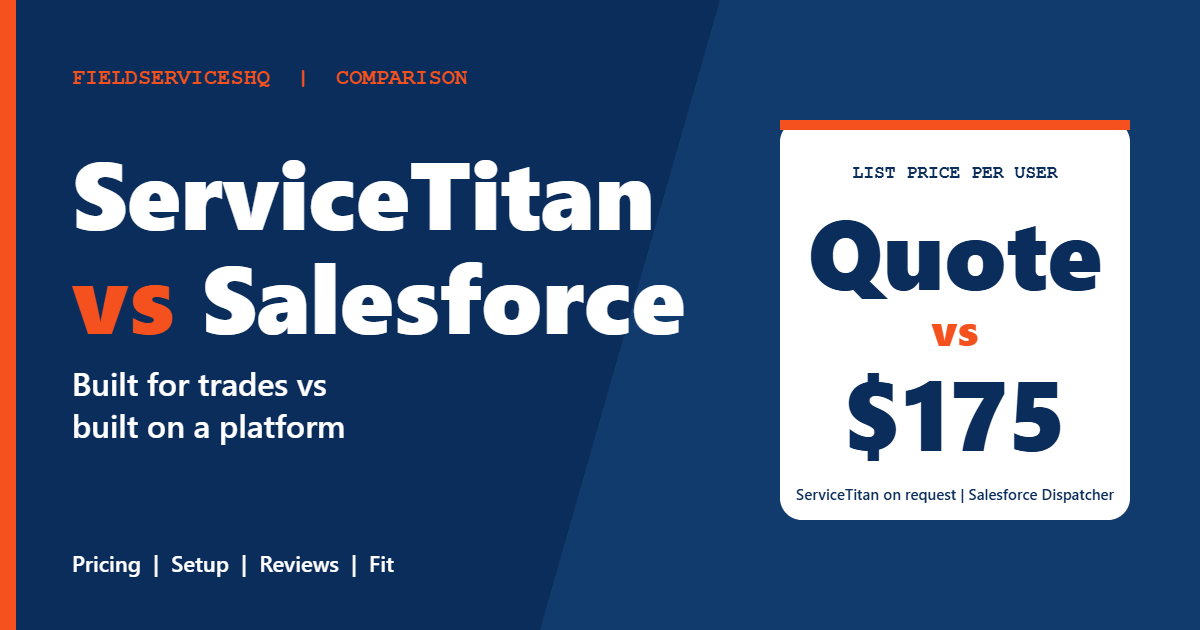
That difference shows up in price, in setup and in who ends up happy. Salesforce publishes per-user list prices, while ServiceTitan asks for a quote. G2 puts them level on overall rating and product direction, with Salesforce ahead on ease of setup and support. This guide goes through the vendor pages, the G2 data and the cost math, so you can tell which model matches your business.
ServiceTitan vs Salesforce Field Service at a glance
| Factor | ServiceTitan | Salesforce Field Service |
|---|---|---|
| Built for | Trades contractors | Many industries, enterprise-grade |
| Published pricing | No, per-technician quote | Yes, per user per month, annual contract |
| Entry list price | Quote | Dispatcher and Technician $175 per user per month |
| G2 rating | 4.4 out of 5 (375 reviews) | 4.4 out of 5 (1,049 reviews in G2’s FAQ) |
| Ease of setup (G2) | 6.7 | 7.8 |
| Quality of support (G2) | 7.7 | 8.6 |
| Product direction (G2) | 8.9 | 8.9 |
| Largest reviewer segment | Small business | Mid-market |
| Time to implement (G2) | 6 months | 6 months |
What each vendor publishes
ServiceTitan
The ServiceTitan pricing page states per-technician pricing and shows no amounts. Starter includes dispatching, scheduling, call booking, invoicing and a pricebook. Essentials adds mobile estimates and payroll management. The Works adds configurable payroll, advanced reporting, commission tracking and customizable memberships. Several Pro products, payments and financing options are listed separately without prices, and the page has no contract terms.
Salesforce Field Service
The Salesforce Field Service and Operations pricing page lists per-user prices billed annually: Frontline Workforce Management at $30, Dispatcher at $175, Technician at $175, Contractor+ at $80 per user or $32 per login, Field Service+ Core at $250, Field Service+ Advanced at $450 and Field Service Max at $650. Those apply to Enterprise Edition. Footnotes give Unlimited Edition rates of $330 per user per month for Dispatcher and Technician and $380 for Field Service and Operations Plus.
The conditions matter as much as the prices. Every per-user product requires an annual contract. Field Service and Operations requires at least one Service Cloud user license, and technicians and contractors need at least one dispatcher license to use the scheduling tool. Some AI capabilities require Flex Credits, with the higher editions including allotments. Add-ons such as Agentforce for Field Service, Asset Service Lifecycle Management, Visual Remote Assistant, Appointment Assistant and Connected Assets are listed without prices. The page itself says it is for information purposes only and subject to change.
Note that G2’s comparison page lists older figures ($165 for Dispatcher and Technician, $50 and $75 for Contractor tiers). Use the vendor page and confirm with your account executive.
The real cost of each approach
Salesforce’s advantage is transparency. You can calculate a baseline license cost from the page, and you can see the editions where AI and advanced features sit. Its disadvantage is that the baseline is only the beginning. You also need a Service Cloud license, and a platform that is built to be configured usually means paying for configuration, whether through a consulting partner or an internal admin. Neither the page nor G2 gives a number for that, so ask for a statement of work.
ServiceTitan’s cost is the opposite shape. You cannot see it in advance, but the product arrives with trades workflows already built. G2 reviewers cite high costs, expensive add-ons and contract rigidity. Outside estimates circulate for per-technician pricing and implementation, but those come from competitors and review sites, not ServiceTitan, and they disagree with each other. Use them to frame questions only.
Both are rated at the top of G2’s perceived-cost scale, with average discounts of 13 percent for Salesforce and 9 percent for ServiceTitan. Reviewers note that Salesforce can justify its cost for larger teams.
The sensible comparison is three-year total cost of ownership, including licenses, implementation, training, administration, add-ons and payment processing.
Features compared
Dispatch and scheduling
ServiceTitan builds dispatch around trades work, with a dispatch board, call booking and optional Scheduling Pro and Dispatch Pro products. Salesforce lists work orders, assets, workforce management, a mobile app and scheduling in its Dispatcher and Technician editions, and G2 reviewers praise scheduling management heavily, with 103 mentions. Reviewers also mention AI dispatch and route optimization on the Salesforce side.
Pricebook, memberships and trades workflows
This is ServiceTitan’s home turf. Pricebook, mobile estimates, memberships, call booking and commission tracking arrive as standard concepts. Salesforce can model these, but you configure them on the platform, or add apps from its marketplace.
Customization
Salesforce is the stronger choice when your process does not fit a template: custom objects, workflows and integrations across sales, service and operations. ServiceTitan’s customization is more bounded, which is also why it can be faster to adopt.
CRM and the rest of the business
If you already manage customers, quotes or marketing in Salesforce, adding Field Service keeps one customer record. ServiceTitan covers CRM-like functions for trades but is not a general CRM.
AI
Salesforce lists AI capabilities and Flex Credits, with the Field Service Max edition including the full AI suite. ServiceTitan lists an AI Virtual Agent as a Pro product. Ask both for live demos and clear pricing for AI usage.
What reviewers say on G2
| Category (out of 10) | ServiceTitan | Salesforce Field Service |
|---|---|---|
| Meets requirements | 8.7 | 8.6 |
| Ease of use | 8.3 | 8.3 |
| Ease of setup | 6.7 | 7.8 |
| Ease of admin | 8.0 | 8.3 |
| Quality of support | 7.7 | 8.6 |
| Good business partner | 8.6 | 8.7 |
| Product direction | 8.9 | 8.9 |
The two products are remarkably close, with Salesforce ahead on setup (7.8 against 6.7) and support (8.6 against 7.7). The reviewer mix explains some of this: ServiceTitan’s largest segment is small business and Salesforce’s is mid-market.
The themes add color. Salesforce reviewers cite ease of use (109) and scheduling management (103) as strengths, and improvement needed (127) and learning curve (84) as downsides. G2’s FAQ adds complex setup and mobile app performance. ServiceTitan reviewers cite ease of use (35) and customer support (27) as strengths and learning curve (20) and improvement needed (19) as downsides. G2 shows six months to implement and six months to return on investment for both, though the page notes those figures look duplicated, so we would not lean on them.
Which one fits which business
ServiceTitan tends to fit when
- You are a residential or light-commercial trades company that wants proven workflows out of the box.
- You prefer a vendor that speaks your trade’s language, from pricebook to memberships.
- You want to avoid hiring a consultant to build your process.
Salesforce Field Service tends to fit when
- You already use Salesforce for sales or service, and a single customer record matters.
- You operate across industries, regions or complex asset types that a trades template would not fit.
- You have, or will hire, Salesforce admin skills.
- You want transparent per-user list pricing for budgeting, and you can absorb the annual contract.
Three examples
A fifteen-truck HVAC contractor with no IT staff. ServiceTitan’s out-of-the-box trades workflow is the safer fit. Salesforce could work, but you would pay a partner to build what ServiceTitan ships.
A manufacturer’s field service team that repairs industrial equipment. Assets, warranties, parts and multi-site customers are better served by a configurable platform. Salesforce’s asset and work order model, plus its marketplace, is designed for this.
A regional facility services company already on Salesforce for sales. Adding Field Service avoids a second customer database. Ask your account executive for the full edition, license and credit math.
A practical evaluation plan
- Decide whether your processes are standard trades processes or genuinely unusual.
- Ask ServiceTitan for a written quote with licenses, implementation and add-ons.
- Ask Salesforce for the exact editions, Service Cloud requirements, Flex Credits and any partner estimate for configuration.
- Build the same workflow in both demos, from booking to invoice.
- Compare three-year cost, not first-month price.
For related reading, see ServiceTitan vs BuildOps, ServiceTitan vs Simpro and Housecall Pro vs ServiceTitan.
Mistakes to avoid
Do not read the Salesforce price list as the total. The Service Cloud requirement, credits, add-ons and configuration all sit outside the per-user figure.
Do not assume transparency means cheaper. A published price helps you plan, but it does not tell you whether the total is lower than a quote.
Do not underestimate administration. A configurable platform needs an owner, even after launch.
ServiceTitan vs Salesforce Field Service FAQ
How much does Salesforce Field Service cost?
Salesforce lists Dispatcher and Technician at $175 per user per month on Enterprise Edition, Contractor+ at $80 per user or $32 per login, and higher editions at $250, $450 and $650. Annual contracts apply, and a Service Cloud license is required.
How much does ServiceTitan cost?
ServiceTitan does not publish prices. Its pricing page describes per-technician pricing and directs you to request pricing.
Which has better G2 reviews?
Both score 4.4. Salesforce Field Service has far more reviews, and it leads on ease of setup (7.8 against 6.7) and support (8.6 against 7.7).
Which is easier to set up?
According to G2, Salesforce Field Service, but both have six-month implementation figures and learning-curve complaints.
Which is better for HVAC and plumbing?
ServiceTitan is built for trades and includes pricebook, memberships and call booking. Salesforce can be configured to do the same, with more effort.
Does Salesforce Field Service require other Salesforce licenses?
Yes. Field Service and Operations requires at least one Service Cloud user license, and technicians and contractors need at least one dispatcher license to use the scheduling tool.
Is there a contract?
Salesforce states that all per-user products require an annual contract. ServiceTitan’s pricing page does not state contract terms, so ask in writing.
Which is better for a small business?
ServiceTitan’s reviewers are mostly small businesses, and Salesforce’s mostly mid-market. A small trades company usually fits ServiceTitan or a lighter tool better than a configurable enterprise platform.
The bottom line
ServiceTitan is the ready-made trades platform, and Salesforce Field Service is the configurable platform with published seat prices. For most trades contractors without Salesforce expertise, ServiceTitan or a lighter alternative will be the easier path. For companies already on Salesforce, or with complex asset and multi-industry needs, Salesforce Field Service deserves a serious look. Either way, compare three-year total cost, not the sticker.
Sources: ServiceTitan pricing, Salesforce Field Service and Operations pricing, G2 comparison of Salesforce Field Service and ServiceTitan.