Salesforce Field Service vs Oracle Field Service: Published Editions or a Sales-Led Quote?
Salesforce Field Service and Oracle Field Service are both enterprise platforms for scheduling, routing and managing mobile workers, and both are usually evaluated by organizations with complex dispatching, large technician populations and existing enterprise software. They are not tools you trial on a Friday and roll out on Monday. The choice tends to follow the rest of your stack.
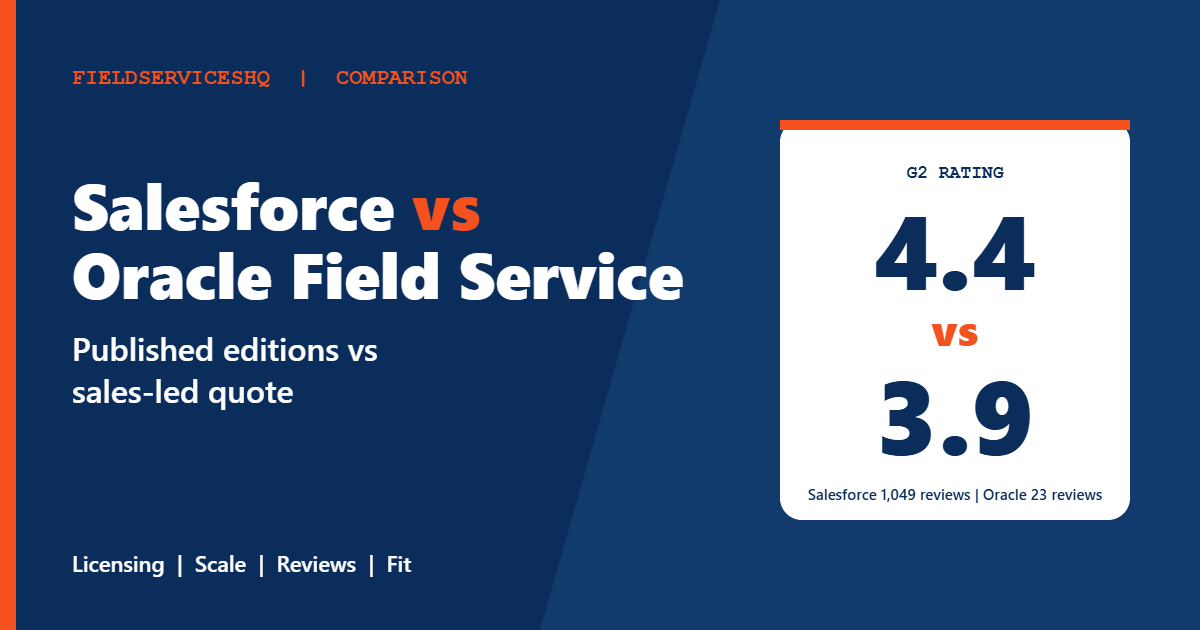
The public record is uneven. Salesforce publishes an edition ladder from $175 to $650 per user per month on annual contracts. Oracle’s pricing page could not be retrieved for this review, G2 lists no price for it, and outside estimates range widely and are unverified. On G2, Salesforce scores 4.4 from 1,049 reviews, while Oracle Field Service scores 3.9 from only 23 reviews, 62 percent of them from enterprise buyers. This guide sets out what is verifiable, where the evidence is thin and how to evaluate both without being misled by a small sample.
Salesforce Field Service vs Oracle Field Service at a glance
| Factor | Salesforce Field Service | Oracle Field Service |
|---|---|---|
| Published pricing | $175 to $650 per user per month by edition | None found; outside estimates unverified |
| Contract | Annual contract for per-user products | Not retrieved |
| Free trial | Service Cloud free for 30 days | None listed on G2 |
| G2 rating | 4.4 (1,049 reviews) | 3.9 (23 reviews) |
| Largest G2 segment | Mid-market | Enterprise (about 62 percent of reviews) |
| G2 ease of use | 8.3 | 7.6 |
| G2 quality of support | 8.6 | 7.6 |
| G2 product direction | 8.9 | 7.5 |
| Time to implement (G2) | About 6 months, 81 responses | Not enough data |
| Time to ROI (G2) | About 14 months, 79 responses | Not enough data |
What each vendor publishes
Salesforce Field Service
The Salesforce pricing page lists these per-user monthly prices, billed annually:
| Edition | Price per user per month | Highlights |
|---|---|---|
| Frontline Workforce Management | $30 | Forecasting, capacity planning, shift scheduling |
| Dispatcher | $175 | AI-powered scheduling and route optimization, real-time visibility |
| Technician | $175 | Offline work order updates, quotes and payments in the field |
| Contractor Plus | $80, or $32 per login | Contractor portal and mobile access |
| Field Service+ Core | $250 | Dispatcher and Technician features plus Service Cloud, Sales Cloud and Slack |
| Field Service+ Advanced | $450 | Field service intelligence and security tooling |
| Field Service Max | $650 | Full AI suite, visual remote assistant, connected assets |
The page states that all per-user products require an annual contract, that Field Service requires at least one Service Cloud license and that Dispatcher and Technician licenses cannot be used for contact center or case management. Service Cloud is free for 30 days. The page also notes that pricing is for information only and subject to change. G2 still shows an older $165 for Dispatcher.
Oracle Field Service
We could not retrieve Oracle’s own pricing page, and G2 lists no entry price for Oracle Field Service. Third-party sources fill the gap with conflicting figures. SelectHub says pricing varies with users and features and typically falls between $100 and $200 per user per month on annual billing. ERP Research cites $300 per user per month as a list rate. Neither is an Oracle statement. A directory lists the starting price as contact vendor, which is the safest reading.
On G2, Oracle Field Service reviewers praise customer support and real-time data, and mention a learning curve, customization difficulties and implementation cost that is high for small companies. A Capterra reviewer notes that installation and configuration require dedicated resources. Gartner Peer Insights lists Oracle Field Service and Salesforce Field Service close together on rating, based on snapshots of different dates and sample sizes, so use those pages for current numbers.
The cost question
With one price published and the other not, the honest comparison is a list of questions rather than a calculation.
For Salesforce, the key variables are edition, role mix and prerequisites. A Dispatcher and a Technician each cost $175 on list. If you need Service Cloud or Sales Cloud, Field Service+ Core at $250 bundles them. If you want the full AI suite, Field Service Max is $650. Add contractor roles at $80 or $32 per login, flex credits for some scheduling agent features and any add-ons. Per-user products require an annual contract.
For Oracle, ask what the pricing metric is: user, resource, transaction or a combination. Ask which modules are separate, such as scheduling optimization, mobile, collaboration, customer portal and analytics. Ask whether the platform is sold stand-alone or as part of a wider Oracle agreement, because discounts and terms can differ.
For both, implementation is usually the largest variable. An outside competitor page estimates Salesforce implementation at $15,000 to $50,000 or more for a small rollout, which is only a rough indicator and does not apply to enterprise scale. Ask each vendor and at least two partners for fixed-scope estimates with timelines. G2 shows Salesforce implementation at about six months and ROI at about 14 months from its largest samples, and has too little data for Oracle.
Features compared
Scheduling and optimization
Both are built around scheduling and optimization at scale. Salesforce reviewers on G2 cite scheduling management as a strength, and its Dispatcher edition includes AI-powered scheduling and route optimization. Oracle is positioned for complex dispatching and field resource coordination. Give each your real constraints: skills, certifications, parts, time windows and travel.
Mobile and offline
Salesforce’s Technician edition lists offline work orders, quotes and payment collection. Oracle’s mobile capabilities are not described in the sources we could retrieve, so ask for a field demonstration with weak connectivity.
Customer and asset data
Salesforce Field Service sits on top of CRM and Service Cloud, which is a major reason to choose it if customer cases already live there. Higher editions add connected assets and asset service lifecycle management. Oracle’s value is in integration with Oracle’s customer experience and enterprise suite, so ask how it connects to your ERP and asset records.
AI and automation
Salesforce packages Agentforce for Field Service at higher editions or as an add-on, with Flex Credits for some features. Oracle describes data-driven algorithms for scheduling and routing. Ask for live examples and the pricing model for AI features.
Integration
G2 lists Salesforce integrations such as MuleSoft, Amazon Connect and CRM dashboards, and has too little data for Oracle’s. Confirm the ERP, inventory and billing integrations you need, and who builds them.
What reviewers say
G2’s side-by-side page gives these scores. Oracle’s category response counts are not shown, and its overall sample is 23 reviews.
| Category | Oracle Field Service | Salesforce Field Service |
|---|---|---|
| Meets requirements | 8.2 | 8.6 |
| Ease of use | 7.6 | 8.3 |
| Ease of setup | 7.9 | 7.7 |
| Ease of admin | 7.9 | 8.3 |
| Quality of support | 7.6 | 8.6 |
| Good business partner | 7.5 | 8.7 |
| Product direction | 7.5 | 8.9 |
Salesforce leads six of seven rows, and Oracle is slightly ahead on setup. Because Oracle’s sample is so small, a single enterprise reviewer can move a score by a point. Oracle’s G2 tags are a handful of mentions: customer support (2), ease of use (2) and learning curve (2). Salesforce reviewers cite ease of use (63 mentions in the summary) and scheduling management, and criticize the need for improvement, a steep learning curve, form design issues and cost for smaller teams.
For a broader view, read reviews on Gartner Peer Insights and talk to reference customers, since these platforms are typically bought on enterprise references, not star ratings.
Which one fits which business
Salesforce Field Service tends to fit when
- Your customer, case and sales data already live in Salesforce.
- You want published editions and are prepared for annual contracts.
- You have a Salesforce administrator or partner to configure it.
Oracle Field Service tends to fit when
- You are a large enterprise whose ERP, supply chain and customer experience stack run on Oracle.
- You have complex dispatching across regions and can resource a longer implementation.
- You prefer to negotiate an enterprise agreement with a single vendor.
Three examples
A utility services company with Salesforce Service Cloud. Salesforce Field Service is the natural first quote. Ask whether Field Service+ Core is cheaper than adding Dispatcher and Technician licenses separately.
A telecom installer with Oracle ERP and a large subcontractor network. Oracle’s integration with its own suite is worth a full demonstration. Also ask Salesforce how it would connect to Oracle ERP and who builds it. For a Microsoft-based alternative, see Salesforce vs Dynamics 365 Field Service.
A mid-sized HVAC company comparing enterprise platforms. Both may be heavier than you need. Compare with ServiceTitan vs Salesforce Field Service before committing.
A practical evaluation plan
- Map every role that needs a login and the systems that hold your customer, asset and order data.
- Ask both vendors for a written license and module map with the pricing metric, prerequisites, add-ons and contract term.
- Ask at least two implementation partners for fixed-scope estimates and timelines.
- Run a proof of concept with your real work orders, skills and constraints.
- Check offline mobile behavior and integration with your ERP.
- Speak to two reference customers of similar size at each vendor.
Mistakes to avoid
Do not treat Oracle’s 3.9 as a reliable score. It rests on 23 reviews.
Do not treat outside Oracle price estimates as quotes. They conflict and are not from the vendor.
Do not compare per-user prices alone. Prerequisite licenses, credits, modules and integration work change the total.
Do not skip the partner estimate. Implementation often costs more than the first year of licenses.
Salesforce Field Service vs Oracle Field Service FAQ
Which is cheaper, Salesforce Field Service or Oracle Field Service?
Salesforce publishes $175 for Dispatcher and Technician and up to $650 for Field Service Max. Oracle’s price is not published in the sources we reviewed, and outside estimates are unverified. Get written quotes.
Which has better reviews?
Salesforce scores 4.4 on G2 from 1,049 reviews. Oracle Field Service scores 3.9 from 23. Salesforce also leads six of seven G2 category scores.
How long does implementation take?
G2 shows about six months for Salesforce. There is not enough data for Oracle. Ask partners for scoped timelines.
Does Salesforce Field Service require Service Cloud?
It requires at least one Service Cloud license, and existing Service Cloud customers need at least one Dispatcher license.
Is there a free trial?
Salesforce lists Service Cloud free for 30 days. G2 lists no trial information for Oracle.
Which is better for large enterprises?
Both target large organizations. Oracle’s G2 reviewers are about 62 percent enterprise, and Salesforce’s largest segment is mid-market. The better fit is the one that integrates with your existing systems.
Can small businesses use either?
Both are heavy for small teams. Reviewers cite high cost for smaller teams on Salesforce and high implementation cost for small companies on Oracle.
How do the AI features compare?
Salesforce offers Agentforce for Field Service at higher editions or as an add-on. Oracle describes data-driven scheduling and routing. Ask each for live examples and pricing.
The bottom line
Salesforce gives you a visible price ladder, a much larger review base and a platform that grows out of CRM. Oracle gives you an enterprise vendor with an integrated stack and a quote-led process, with far thinner public evidence. If you are on Salesforce, the choice is mostly about edition mix and partner quality. If you are on Oracle, the choice is mostly about integration and negotiation. Either way, insist on a written license map, a fixed-scope implementation estimate and two references before you sign.
Sources: Salesforce Field Service pricing, G2 comparison of Oracle Field Service and Salesforce Field Service, Oracle Field Service on Capterra, Oracle Field Service on SelectHub.