Zuper, Zinier or OverIT: Choosing Enterprise Field Service Software
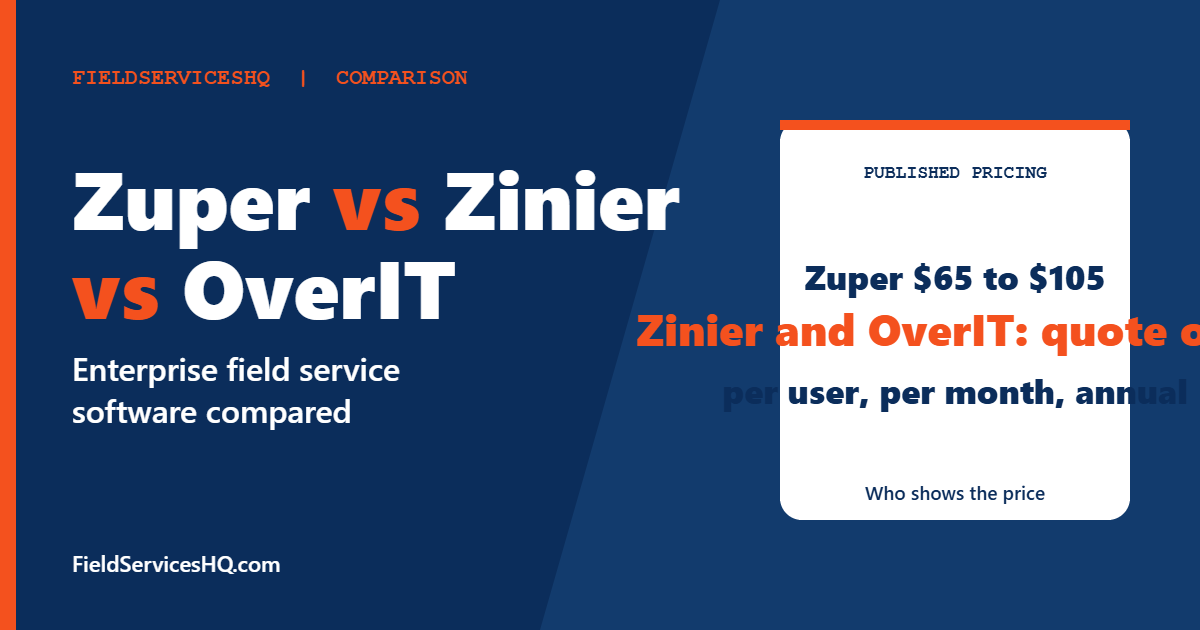
Zuper is the only one of the three that publishes prices: $65, $85 or $105 per user per month on annual billing. Zinier and OverIT sell by quote only. Zuper suits mid-market contractors that want a fast rollout, Zinier suits asset-heavy operators that need low-code workflow building, and OverIT suits large utilities and linear-asset networks that need GIS-style planning at scale.
If you are comparing Zuper, Zinier and OverIT, you are probably past the stage of looking at Jobber-style tools for small crews. These three sit in the mid-market and enterprise end of field service software, where the buying process looks very different. Prices are negotiated, implementation takes months, and the review pool on public sites is thin. This guide pulls together what is publicly documented about each platform so you can walk into a demo with sharper questions.
A note on evidence before we start. Zuper publishes a price card. Zinier and OverIT do not. Where a number comes from a vendor page we say so, where it comes from a directory we flag that directories disagree, and where we have no figure we say that instead of guessing. Review counts are small for two of the three, and we point that out each time because a 4.7 average from 9 reviews means something very different from a 4.7 average from 152.
Zuper vs Zinier vs OverIT at a glance
| Factor | Zuper | Zinier | OverIT |
|---|---|---|---|
| Typical buyer | Mid-market field service companies (HVAC, roofing, plumbing, electrical) | Mid-market and enterprise, asset-intensive sectors such as utilities and telecom | Mid-market and enterprise, linear assets and mission-critical field work |
| Published pricing | Yes, $65 / $85 / $105 per user per month, annual billing | No, contact vendor | No, modular pricing by scope (Gartner) |
| Pricing model | Per user, three tiers | Subscription, reported by Gartner as tied to users and modules | Modular configuration; one Capterra listing shows a flat-rate model |
| G2 rating | 4.7 from 152 reviews | 4.7 from 9 reviews | No direct G2 figure found for this article |
| Gartner Peer Insights | Not checked here | 1 review on the product page | 4.6 across 35 reviews at vendor level |
| Headquarters | United States | San Mateo, California (third-party directory) | Fiume Veneto, Italy (Gartner) |
| Standout trait | Transparent tiers, AI tools on higher plans | Low-code platform for custom field apps | Two decades of enterprise FSM, GIS and engineering integrations |
Sources for this table are listed at the end. The G2 and Gartner figures were read in November 2026 and will drift as new reviews arrive.
What each platform is built for
Zuper
Zuper positions itself for mid-market and enterprise service companies, with trades such as roofing, HVAC, plumbing and electrical named on its Software Advice profile. Its three packages are Starter, Core and Premium. Per its pricing page, Starter is $65, Core is $85 and Premium is $105 per user per month on annual billing. The Core tier is described as adding the Zuper AI tools, optimized routing, multi-warehouse inventory and asset management.
That makes Zuper the easiest of the three to model in a spreadsheet. You can multiply seats by a published rate and see a floor for your software line before you ever speak to sales. The catch is what sits outside that rate. A third-party directory notes that professional services for onboarding, integrations and configuration are scoped separately, that a Zuper Connect add-on starts at $199 per month, and that Zuper Pay carries transaction and terminal fees. Treat those as items to confirm on a quote, not as final numbers.
Zinier
Zinier describes itself as a cloud-based field service automation platform with a low-code and no-code layer for building custom field workflows. Capterra lists it for mid-market and enterprise companies in asset-intensive sectors such as utilities and telecommunications, with a presence across North America, Latin America, EMEA and APAC. Its listed feature set is broad and covers dispatch, scheduling, work orders, inventory, service history, routing and time tracking.
Pricing is not published. Gartner describes the model as subscription based and shaped by user counts and the modules chosen, with detail available only through direct engagement. G2 says plainly that Zinier has not provided pricing information. If Zinier is on your shortlist, plan on a sales-led evaluation and ask for a written scope that separates licences, configuration work and ongoing support.
OverIT
OverIT is the oldest of the three. Gartner lists it as a private company founded in 1999, headquartered in Fiume Veneto, Italy, with 501 to 1,000 employees. Capterra describes the Next-Gen FSM platform as designed for mid-market and enterprise organizations managing linear asset operations and mission-critical field work, with integrations listed for ESRI ArcView, NX and Oracle Service. Those mapping and engineering links matter if your crews maintain pipes, cables, grids or rail.
Gartner says the software is modular and that pricing reflects the scope and complexity of the configuration. One Capterra regional listing shows a flat-rate pricing model, which is a reminder that directory labels are not contracts. Expect a project-style engagement rather than a credit card sign-up.
What the pricing evidence actually shows
Only Zuper gives you real numbers, so here is simple arithmetic on its published per-user rates. This is our own multiplication, not a vendor quote, and it excludes onboarding, add-ons and payment fees.
| Users | Starter ($65) per month | Core ($85) per month | Premium ($105) per month |
|---|---|---|---|
| 10 | $650 | $850 | $1,050 |
| 25 | $1,625 | $2,125 | $2,625 |
| 50 | $3,250 | $4,250 | $5,250 |
Annualized, 25 users on Core comes to $25,500 and 50 users on Premium to $63,000. G2 shows Zuper’s perceived cost at its highest band, an average discount of 7 percent, an average implementation time of 3 months and an average time to return on investment of 7 months. Those G2 averages come from a limited reviewer pool, so use them as a rough planning range rather than a promise.
Directories disagree on Zuper’s entry price. Capterra and Software Advice show $39 per user per month, GetApp shows a $29 starting figure, and another aggregator quotes $35. The vendor’s own pricing page, repeated by a pricing tracker that reported confirming it in October 2026, shows $65 as the floor. When sources conflict, trust the vendor page and ask for a quote in writing.
For Zinier and OverIT, there is no responsible number to put in a table. Anyone quoting a precise per-user price for either platform from a blog is guessing. Ask each vendor for a three-year total cost of ownership that includes licences, implementation partner fees, integrations, training and support tiers.
Reviews: how much weight each score deserves
| Platform | Source | Score | Sample size |
|---|---|---|---|
| Zuper | G2 | 4.7 | 152 reviews |
| Zuper | Software Advice | 4.5 | 56 reviews |
| Zinier | G2 | 4.7 | 9 reviews |
| Zinier | Gartner Peer Insights | Not shown | 1 review |
| Zinier | Capterra | 0.0 shown | 0 reviews |
| OverIT | Gartner Peer Insights (vendor level) | 4.6 | 35 reviews |
Zuper has the deepest public review pool, and its 4.7 on G2 is based on a sample large enough to take seriously. Zinier’s G2 rating rests on 9 reviews, several of which are short, so it tells you the people who responded were happy and not much more. The Zinier reviewers who wrote detail praised the low-code approach for speeding up field app development and mentioned wanting more pre-built templates for specific use cases. OverIT’s Gartner score covers 35 reviews across its products at the vendor level, which is small by consumer software standards but typical for enterprise FSM, where each customer is a large account.
The practical lesson: for Zinier and OverIT, reference calls beat star ratings. Ask each vendor for three customers of your size and sector, and ask what went wrong during rollout.
Implementation and time to value
Enterprise field service projects rarely fail on features. They fail on data migration, integrations and adoption. Plan around these realities:
- Zuper: G2 reports an average 3 month implementation. Confirm what is included, because onboarding and integrations can be scoped separately.
- Zinier: the low-code platform lets teams build custom workflows, which is powerful but shifts effort onto your configuration team or a partner. Ask who owns changes after go-live.
- OverIT: enterprise deployments usually involve GIS, asset registers and ERP links. Ask for a sample project plan with milestones and the roles you must supply from your side.
- All three: budget internal time for technician training, since a tool that dispatchers love and crews avoid delivers little.
Which platform fits which buyer
- You run 20 to 150 technicians in the trades and want to see prices up front: start with Zuper. The published tiers make internal approval simpler.
- You operate telecom, utility or infrastructure field teams and want to design your own workflows: Zinier’s low-code positioning is the reason to take the call.
- You maintain linear or geographic assets and need mapping and engineering tie-ins: OverIT’s integration list and long enterprise history point that way.
- You already run Salesforce or Microsoft: compare these three against native options too. Our guides on Salesforce Field Service vs Dynamics 365 Field Service and the wider Salesforce vs Dynamics 365 vs Oracle cost breakdown show how those costs stack up.
- You service assets under contract and care about installed-base data: read IFS Field Service vs ServiceMax and ServiceMax vs Salesforce Field Service.
- You are a commercial or mechanical contractor weighing job costing: see ServiceTitan vs BuildOps and Simpro vs BuildOps.
Eight demo questions that expose the real cost
- What is the total first-year cost for our user count, including implementation, integrations and payment fees?
- Which features in your demo belong to higher tiers or paid add-ons?
- How long did your last three customers of our size take to go live, and what delayed them?
- What does the contract say about price increases at renewal?
- How do we export our data if we leave?
- Which of our existing systems integrate natively, and which need custom work?
- Who supports technicians after hours, and is that included?
- Can we speak with a customer that migrated from a competitor in our sector?
Prices for Zuper come from its published pricing page as reported in November 2026. Zinier and OverIT prices were not available, so none are stated. Ratings come from G2, Software Advice and Gartner Peer Insights and reflect small samples for Zinier and OverIT. Cost tables are our own arithmetic.
Mistakes to avoid
- Comparing a published per-user price against a quote-only platform as if they were equal. The quoted platform may cost more or less once scope is fixed.
- Reading a 4.7 rating without checking whether it comes from 9 reviews or 152.
- Ignoring professional services, payment processing and add-on fees when budgeting.
- Skipping reference calls with customers in your own sector.
- Letting a low-code platform become a permanent custom build with no owner.
Zuper vs Zinier vs OverIT FAQ
Which is cheaper, Zuper, Zinier or OverIT?
Only Zuper publishes prices, at $65, $85 or $105 per user per month on annual billing. Zinier and OverIT use quotes, so a fair cost comparison requires written proposals for the same scope and user count.
Does Zuper have a free plan?
Its published tiers are paid, starting at $65 per user per month. Some directories list a free trial or free version flag, but those labels vary by site, so confirm trial terms with Zuper directly.
Is Zinier a low-code platform?
Yes. Zinier describes a low-code and no-code layer for building custom field service solutions, and a G2 reviewer credited it with speeding up field app development.
What industries does OverIT serve?
Capterra describes OverIT for mid-market and enterprise organizations running linear asset operations and mission-critical field service, and its listed integrations include ESRI ArcView, NX and Oracle Service.
How long does Zuper take to implement?
G2 reports an average implementation time of 3 months and an average time to return on investment of 7 months. Your timeline depends on integrations and data migration.
Are these platforms suitable for small businesses?
Usually not. All three target mid-market or enterprise buyers. A small crew is better served by tools covered in our Jobber comparisons or other small-business guides.
Can I trust directory prices for Zuper?
Treat them with caution. Capterra and Software Advice show $39, GetApp shows $29, while the vendor page shows $65 as the starting rate. Use the vendor page and get a written quote.
What should I compare besides price?
Compare implementation effort, integration depth, mobile experience for technicians, reporting, support terms and contract flexibility. Gartner’s Market Guide for Field Service Management is a useful neutral reading list for the category.
Sources
- Zuper reviews on G2
- Zuper pricing page
- Zuper on Software Advice
- Zinier on G2
- Zinier on Gartner Peer Insights
- Zinier on Capterra
- OverIT on Gartner Peer Insights
- OverIT Next-Gen FSM on Capterra